In the right environment, Waste Heat to Power (WHP) can help make on-site power architecture more productive, reduce wasted thermal energy, and support a more resilient infrastructure model.

Waste Heat to Power as a Reliability Play
SUMMARY
Waste heat-to-power (WHP) systems can strengthen site reliability and resilience by helping data centers:
Recover usable electricity from waste thermal energy across cooling systems, reciprocating engines, fuel cells, and other onsite power infrastructure
Reduce effective net grid dependence while improving utilization of onsite energy assets
Reduce operational pressure by lowering thermal rejection burden and strengthen integration between power and cooling architecture
Improve operational flexibility and resilience under constrained grid, fuel, or interconnection conditions
Enable onsite power systems to operate more effectively and for longer durations by recycling waste heat into usable power
Add an incremental resilience and redundancy layer beyond conventional backup systems
Potentially reduce the scale of fossil-fuel-fired backup infrastructure required, while easing associated permitting and emissions constraints
Create a more productive, flexible, and capacity-efficient site energy architecture for next-generation AI infrastructure
WHP should not be viewed simply as an efficiency technology. In next-generation data centers, it can function as an architectural layer that helps make the full site energy system more resilient, reliable, productive, and strategically valuable.
——————————————————————————————
Reliability in data centers is becoming a broader systems question. Backup power still matters, but it is no longer the full picture. Grid congestion, delayed interconnection, higher rack density, and tighter thermal margins are making resilience more dependent on how the full site energy system performs every day. That is where waste heat-to-power becomes more relevant. In the right environment, Waste Heat to Power (WHP) can help make on-site power architecture more productive, reduce wasted thermal energy, and support a more resilient infrastructure model.
Reliability in data centers has traditionally been defined by one question: what happens when the grid fails? That is why backup architecture has long centered on diesel generators, UPS systems, batteries, redundancy design, and layered electrical protection.
That model still matters, but it was built for a world where reliability was mainly about surviving discrete outages.
Today, it is no longer only about how to survive loss of supply. It is also about how to build an energy architecture that is more resilient, more productive, and less exposed to external constraints under normal operating conditions.
That is where waste heat to power becomes relevant. In the right environment, WHP can support resilience by improving how a site uses thermal and power flows, reducing wasted energy, and strengthening on-site energy architecture.
Reliability Is No Longer Just About Emergency Backup
For years, reliability planning has focused on equipment layers:
Utility redundancy
UPS architecture
Battery systems
Diesel generation
N+1 and 2N configurations
These remain essential. But they are no longer enough to describe the full reliability picture.
A modern data center also has to deal with:
Grid access constraints
Long interconnection timelines
Greater cooling dependence
Higher thermal density
More expensive or harder-to-secure incremental power
Larger compute loads with tighter infrastructure margins
That shifts reliability from a narrow backup discussion into a broader infrastructure discussion.
A site can be technically redundant and still be strategically constrained.
That is why operators, site engineers, and reliability engineers are increasingly being pushed to think beyond “what turns on when the power goes out?” and toward “how does the full energy system perform under normal and stressed conditions?”
Diesel Backup isn't the Full Story
Diesel generators are still the standard backup model across the data center industry. They are proven, widely deployed, and built into the operating assumptions of many facilities.
But the limitations of a diesel-only reliability model are becoming clearer. These include:
Fuel logistics
Emissions pressure
Underutilized standby equipment
Rising interest in cleaner on-site systems
This is where WHP becomes relevant.
WHP does not replace diesel backup, but it can make the broader power system more productive by helping recover useful value from heat that would otherwise be rejected, especially when that heat comes from:
Continuous IT loads
On-site reciprocating engines, including diesel engines
Fuel cells
Other behind-the-meter energy systems
That gives operators a different kind of reliability advantage. The site is not only protected during outages with the diesel engine + WHP - it can also become more productive and less dependent on external constraints during normal operation.
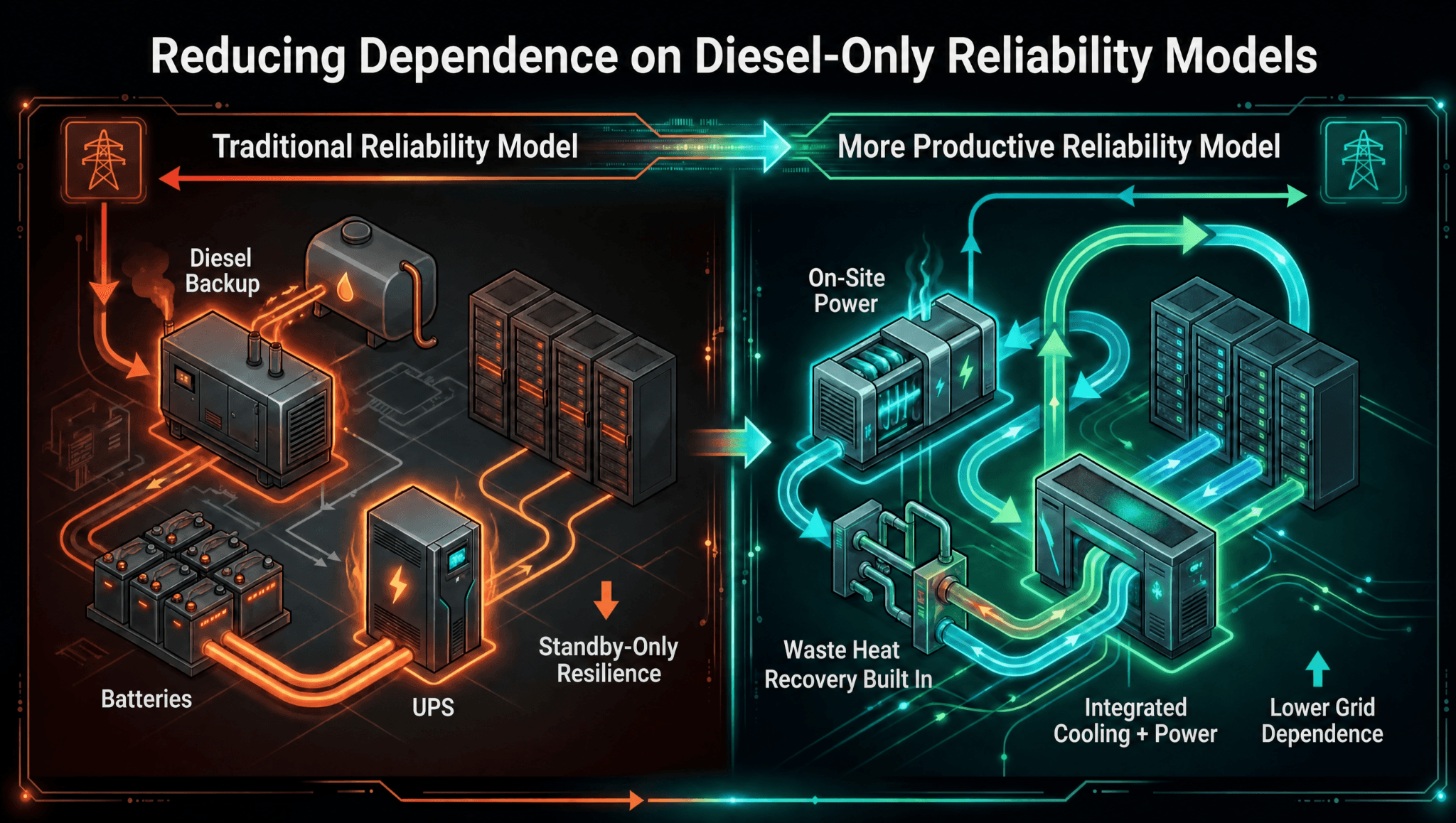
On-Site Power Makes the Reliability Case Stronger
As grid constraints continue to slow growth, operators are increasingly looking at on-site generation to support new capacity. Assets like gas engines and fuel cells not only produce electricity, but also produce large thermal streams.
This is where WHP becomes more than a heat reuse story.
Reciprocating engines, for example, can reject roughly 55–60% of fuel energy as heat, which can mean more thermal output than electrical output. Exhaust temperatures between 200-400°C create a meaningful recovery opportunity.
For operators and site engineers, this changes how on-site power should be evaluated.
The question is no longer only:
How much backup or bridge power does this system provide?
It becomes:
How much additional site value can be recovered from the thermal side of this system?
The same on-site generation assets being installed for resilience or bridge power can become more productive if their waste heat is not simply vented away, but converted into useful electricity.
Reliability Is About Useful Output, Not Just Installed Equipment
A site can have several layers of backup power and still leave infrastructure value untapped.
Traditional reliability planning often measures success through installed hardware:
How many generators
How many UPS paths
How much redundancy
How much fuel backup
Those metrics still matter. But the more useful question for modern infrastructure is broader: how much productive value can the site get from the systems it already operates?
From a reliability perspective, WHP matters because it can support:
Better site energy utilization
Lower wasted thermal burden
Stronger integration between power and cooling architecture
Improved productivity of on-site power systems
Less exposure to single-path energy dependency
This is why WHP should be evaluated as part of a more resilient infrastructure model.
Reliability Also Means Reducing Pressure Across the System
Reliability is not just about surviving catastrophic events.
It is also about lowering operational stress across the facility, which in turn reduces the risk of operational breakdowns.
A site that can recover value from waste heat may be able to:
Lower effective grid draw
Reduce strain on the cooling layer
Improve utilization of on-site energy assets
Create a more stable site energy architecture
Reduce some dependency on external power conditions
That matters even more in AI-scale facilities.
Higher rack density and stronger cooling dependence mean there is less room for thermal inefficiency. Average rack density has increased from 7 kW in 2021 to 16 kW in 2025, while AI-focused environments are already operating at 50–140 kW per rack.
In that kind of environment, power and cooling resilience are tightly connected. That is why WHP deserves to be considered as part of a broader reliability stack.
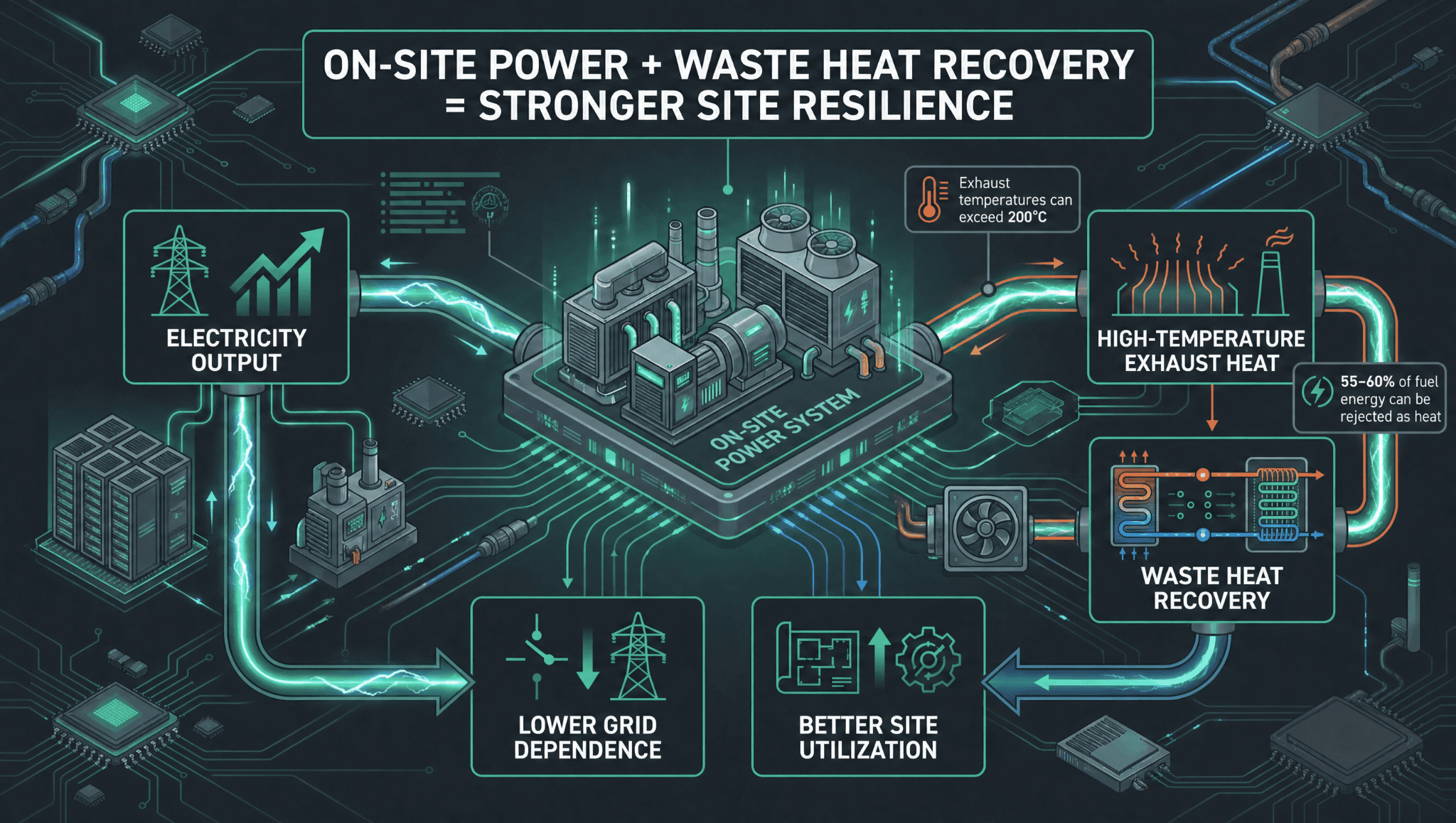
Diesel Is a Backup Tool. WHP Is an Architectural Layer
This distinction is important.
Diesel is usually a standby asset. It exists to protect the site during a failure event.
WHP is different. Its role is not primarily standby. Its value comes from helping the overall site architecture become more productive and more resilient across normal and stressed operating conditions as well.
WHP becomes valuable when it helps make the broader system stronger by:
Recovering energy from heat already being produced
Improving the productivity of on-site generation
Supporting lower net grid dependence
Strengthening the relationship between cooling and power infrastructure
Enabling more flexible site design
WHP should be viewed as an architectural advantage, not just an efficiency add-on.
Reliability Has an Economic Side Too
For data centers, reliability is not only technical. It is also economic.
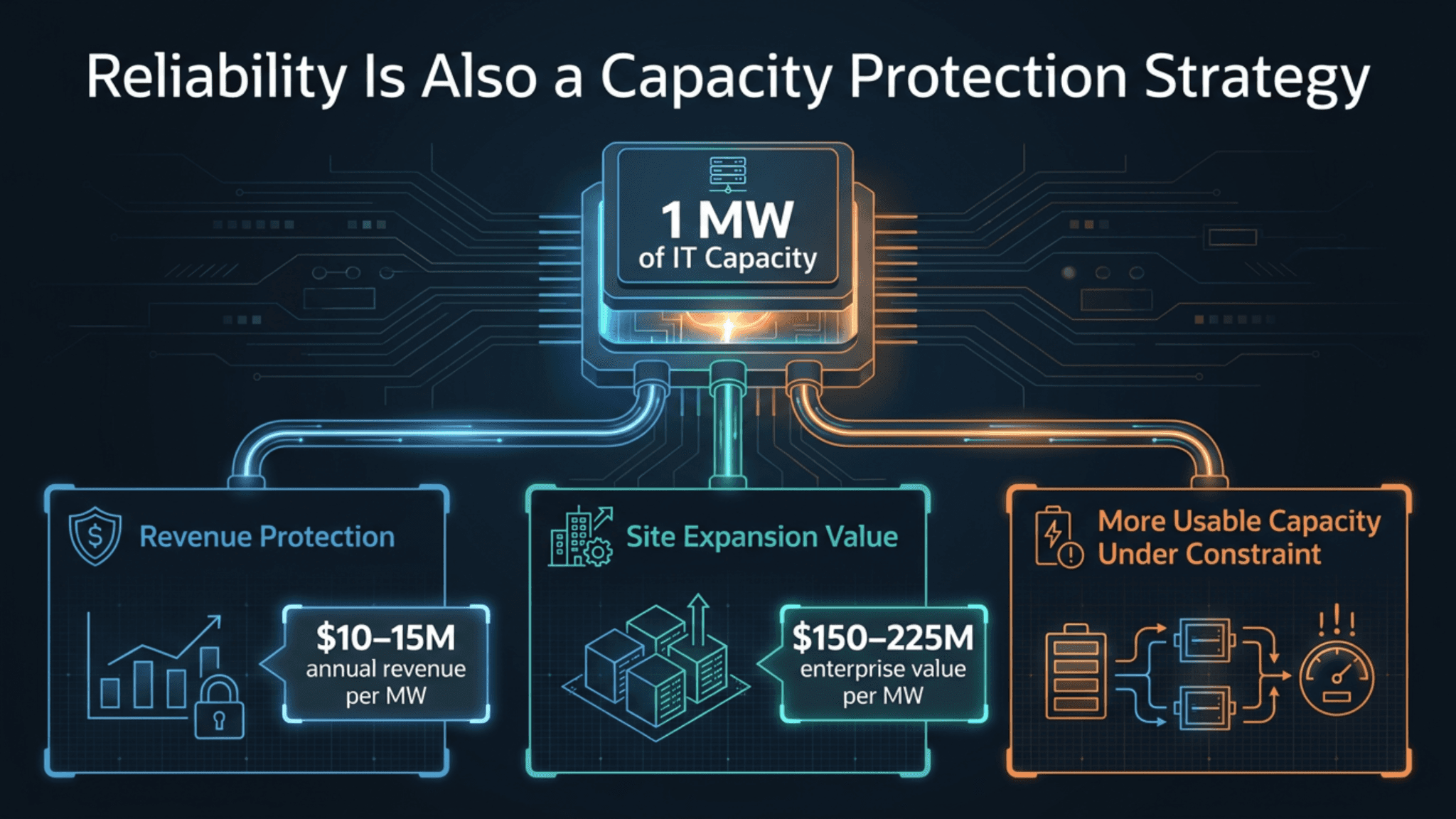
A megawatt of IT capacity is not valuable only because it keeps servers running. It is valuable because it supports compute, revenue, and long-term asset performance.
There is a massive economic benefit per megawatt:
Roughly $10–15 million in additional annual revenue per MW
Roughly $150–225 million in additional enterprise value per MW at hyperscale valuations
That means protecting usable power capacity is also a financial issue.
From that perspective, reliability should be understood not only as uptime protection, but as capacity protection.
If WHP helps make the energy architecture more productive, reduces wasted thermal burden, and improves how the site uses on-site power systems, then it contributes to reliability in a commercially meaningful way.
Reliability in data centers is becoming a broader systems challenge.
Backup equipment still matters. Redundancy still matters. Uptime discipline still matters.
But the next phase of reliability will also be shaped by how intelligently the site uses power, heat, cooling, and on-site generation as one connected energy architecture
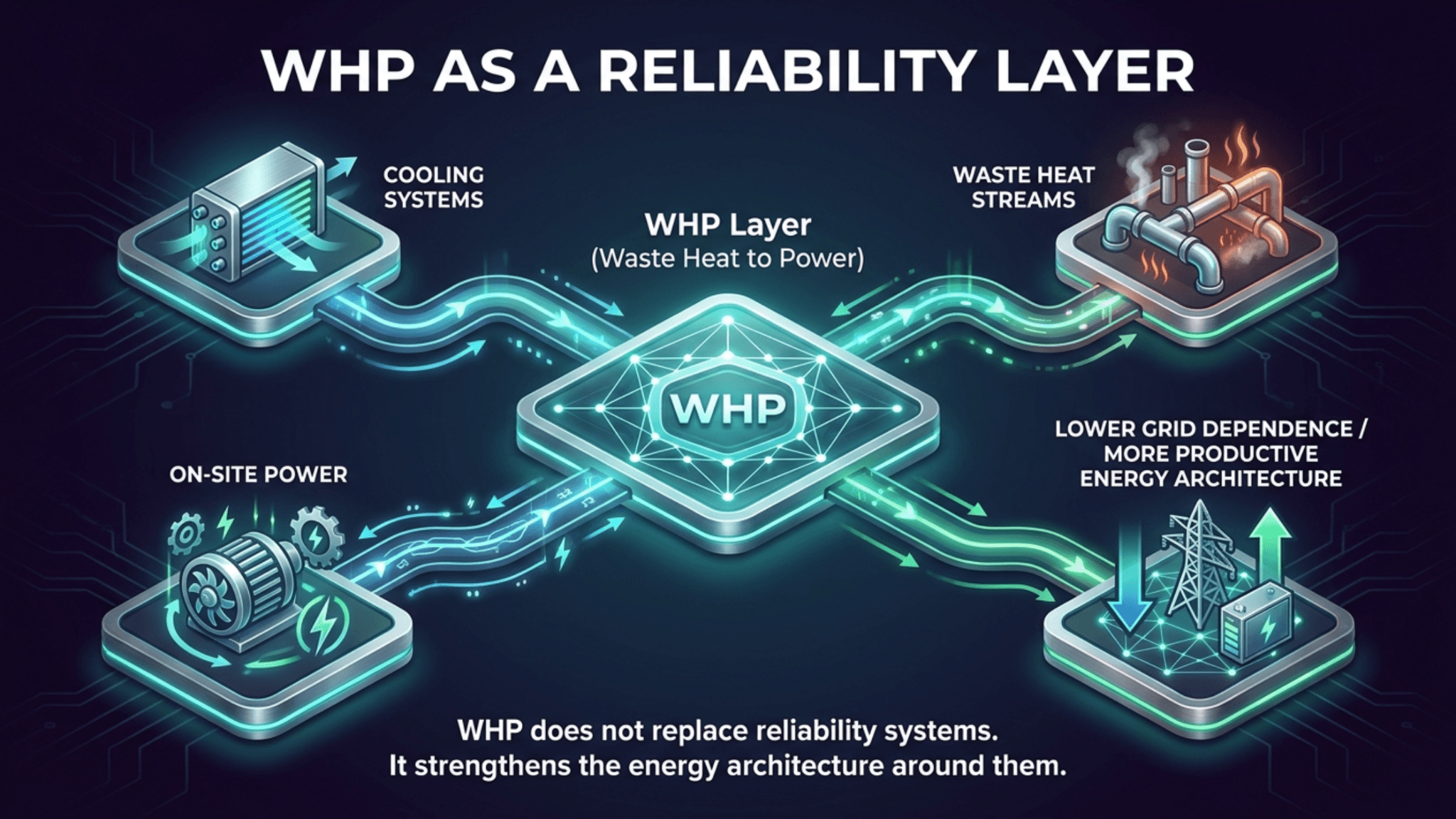
This is where WHP becomes more relevant. Not because it replaces traditional backup tools, but because it can help make the full system more flexible, more productive, and more resilient.
The next generation of reliable data centers may not simply be the ones with the most backup equipment. They may be the ones that can extract the most productive value from every watt, every thermal stream, and every piece of infrastructure already operating across the site.
——————————————————————————————
Reference
1) IEA – Energy and AI
(for grid congestion, interconnection delays, power constraints, and the broader shift in data center reliability thinking)
https://www.iea.org/reports/energy-and-ai/executive-summary
2) Vertiv + Dell – Modernizing Federal IT with AI-Ready Modular Data Centers
(for average rack density around 15 kW in 2024 and some AI deployments at 100 kW+ per rack)
3) Dell’Oro Group – Data Center Liquid Cooling Market to Approach $7 Billion by 2029
(for liquid cooling becoming a functional requirement in large AI environments)
4) Uptime Institute – Data centers without diesel generators: The groundwork is being laid
(for the industry context around reducing dependence on diesel-only backup approaches and interest in cleaner on-site architectures)
https://journal.uptimeinstitute.com/data-centers-without-generators-the-groundwork-is-being-laid/
5) U.S. Department of Energy – Review of Combined Heat and Power Technologies
(for reciprocating engine waste heat, exhaust heat recovery, and typical exhaust temperature ranges)
https://www.energy.gov/sites/prod/files/2013/11/f4/chp_review.pdf
6) Lawrence Livermore National Laboratory – Estimated U.S. Energy Consumption in 2023
(for broader waste heat / rejected energy context across infrastructure)
https://flowcharts.llnl.gov/sites/flowcharts/files/2024-10/energy-2023-united-states.pdf
About
Let’s Talk

Assess Your Data Center Waste Heat Reuse Opportunity
We analyze your facility to quantify power recovery, efficiency gains, and integration opportunities.
Explore SPRING Pilot Programs
Get in touch to evaluate a pilot and validate performance in your environment.

104 West 40th Street, New York, NY 10018