Data centers don't just consume power. They concentrate it, then dump it as heat next door. Here's the science behind that problem, why it's turning into a political fight, and how Spar Systems' SPRING platform addresses it at the source.
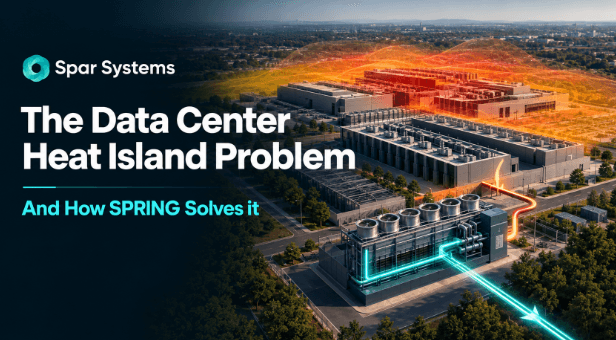
Every megawatt that goes into a data center comes back out as heat. That simple fact of physics is turning into one of the most contentious issues in data center development — right alongside water use, noise, and grid strain. New research from Arizona State University and a University of Cambridge–led team has now put numbers on what communities living near data centers have been describing for years: measurable, localized warming that doesn't show up in a carbon footprint spreadsheet, but shows up on their block.
This is the story of that problem — and of how SPRING, our heat-to-power platform, is built to address it at both of its sources: the heat servers reject, and the heat onsite power generation rejects.
A quick but important distinction
Before going further, it's worth separating two things that get conflated constantly in this conversation:
Term | What it actually means |
Heat dome | A regional meteorological pattern — high pressure trapping hot air over a wide area. No single facility causes one or stops one. |
Urban heat island (UHI) | A persistent, local temperature difference between developed areas and their less-developed surroundings, driven by pavement, buildings, reduced vegetation, and concentrated waste heat. |
A single data center will never create a heat dome. But it absolutely can add to local anthropogenic heat flux, and that's the piece a facility can actually do something about.
What the research now shows
For years, the data center heat conversation was mostly anecdotal: residents near cooling towers and dry-cooler banks describing hot air, warm nights, and discomfort near facility fence lines. In the last several months, two independent research efforts have turned that anecdote into data.
Arizona State University: the first field measurements
Researchers at ASU's School of Geographical Sciences and Urban Planning ran the first published field study of its kind: mobile, vehicle-based temperature transects around operating data centers in the Phoenix metro area, published in the ASME Journal of Engineering for Sustainable Buildings and Cities.
Their findings, in short:
Facilities in the 36–169 MW range produced a measurable, detectable warming signature.
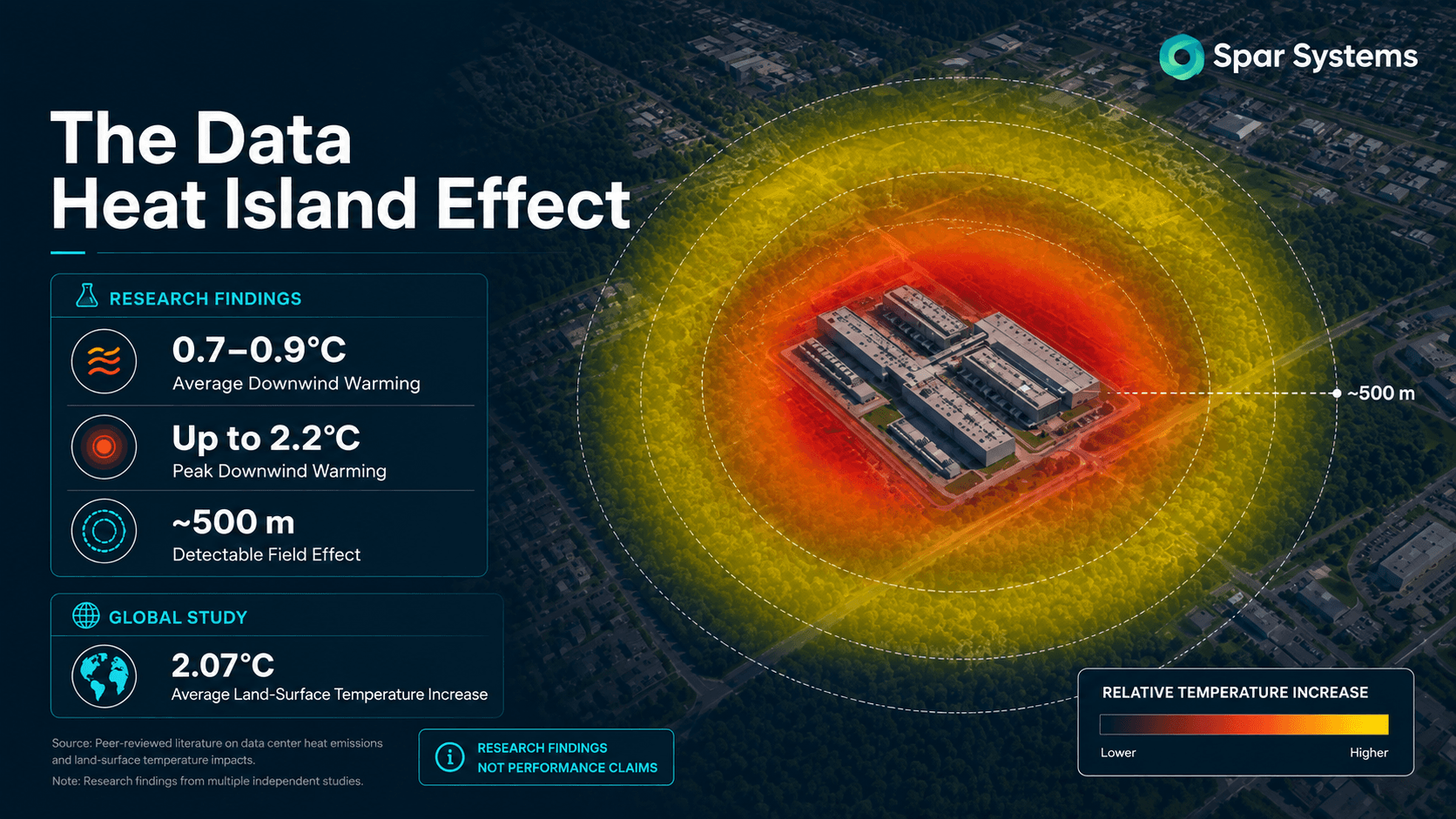
Downwind air temperatures ran 0.7–0.9°C warmer on average than upwind areas at the same time.
Peak downwind warming reached as high as 2.2°C.
The effect was detectable up to roughly 500 meters from the facility boundary.
Their conclusion was blunt: data center waste heat is "a previously undocumented urban thermal hazard" — one that planning departments haven't historically had a framework to evaluate, at exactly the moment facility footprints and power densities are climbing.
University of Cambridge–led team: the global satellite view
A separate, much larger-scale study — led by Andrea Marinoni (University of Cambridge and Glitch Analytics) with co-authors from around the world — took a different approach: satellite land-surface-temperature data at 500-meter resolution, going back to 2004, cross-referenced against a global database of more than 11,000 data center locations.
After filtering to facilities outside dense urban cores (8,472 candidate sites, 6,733 after quality control), the team's findings were striking enough that they gave the phenomenon a name — the "data heat island effect":
Average land-surface-temperature increase after a data center begins operating: 2.07°C, with a range of 0.3°C to 9.1°C across sites
The warming signature is measurable up to 10 km from a facility, with a full 1°C average increase still detectable at 4.5 km.
Across the facilities studied, roughly 343 million people live within 10 km of a data center showing this effect.
Regional case studies made the trend concrete: a sustained ~2°C rise over two decades in Mexico's Bajío data center corridor; a comparable ~2°C anomaly in Aragón, Spain, distinct from neighboring provinces; and a 2.8°C increase near Teresina in Brazil's Ceará/Piauí region, which the authors project could exceed 3.5°C within five years absent mitigation.
Two very different methods — one a hyperlocal field study in the desert Southwest, one a global satellite time series — arrived at a similar order of magnitude: roughly 1–2°C of added local warming, concentrated within a kilometer or so of a facility.This is already happening, and there’s research to back it up.
Why this is becoming a permitting and political problem, not just a technical footnote
Thermal discharge has quietly joined water, noise, emissions, and grid demand as a live issue in data center siting — and the backlash is no longer confined to a handful of rural county commission meetings.
The polling has shifted. A March 2026 Gallup poll found that seven in ten Americans oppose data center development in their own area, with resource impacts, electricity costs, and quality of life cited as the top concerns.
The money is now real. Industry tracking found that local opposition blocked or delayed roughly $64 billion in data center projects between May 2024 and March 2025, with another $98 billion obstructed between March and June 2025 alone — well over $160 billion in stalled investment in about thirteen months.
It's crossed into national politics. In August 2026, the National Republican Senatorial Committee reportedly warned AI companies that data center opposition could become "a sleeper issue for the entire election cycle." When a party campaign committee is issuing warnings about a land-use topic, it has stopped being a local nuisance complaint and become a mainstream political liability.
States are already responding. Virginia's legislature voted 28–12 in 2026 to begin phasing out the state's data center sales-tax exemption, after a legislative audit found the exemption cost the state $928 million in one fiscal year alone. Georgia's legislature passed a similar repeal in 2024, though vetoed by the governor — itself a sign of how contested the issue has become even within a single state government. Virginia has gone further still: a 2026 law now directs data center operators to measure and report facility waste-heat output and evaluate its potential for reuse as part of the state's review process, effectively writing thermal discharge into the permitting conversation directly, alongside water and noise.
The impact can extend beyond the facility itself. Heat rejected from data centers can contribute to higher temperatures in the surrounding area, especially during already-hot conditions.
A real-world example: Memphis
xAI's Colossus supercomputer campus in South Memphis shows what happens when a power island isn't integrated thoughtfully into its surroundings. Aerial imagery showed roughly 35 gas turbines on site (about 422 MW combined), reportedly running for months. Community groups organized around both the emissions and a heavy water draw. The headline issue was air quality and water, not heat — but the same turbines are also exhausting heat at 200–500°C from a compact footprint: exactly the "concentrated power-island heat" scenario new research describes.
Two layers of heat, one root cause
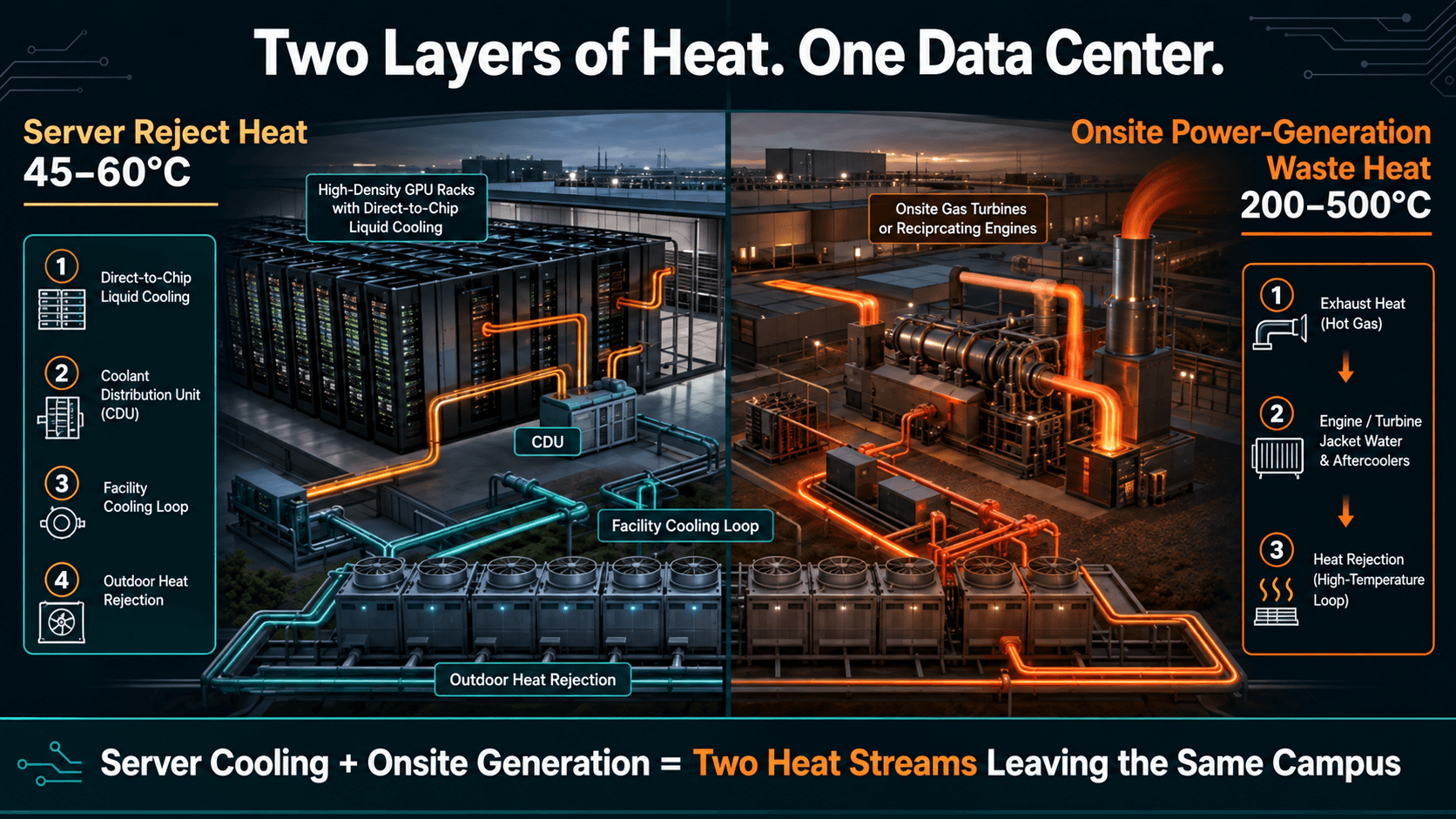
Strip away the politics and the science points to the same underlying structure everywhere: data centers reject heat from two distinct places, at two very different temperatures.
Heat source | Typical temperature | Character of the local impact |
Server reject heat | 45–60°C | Continuous, lower-temperature — dry coolers and cooling towers running around the clock, at facility scale |
Onsite power-generation waste heat | 200–500°C | Intermittent-to-continuous, much hotter, more concentrated — exhaust and cooling heat from turbines, reciprocating engines, and fuel cells at gigawatt-scale power islands |
Liquid cooling — the industry's current answer to rising rack density — improves how heat is collected and moved. It does nothing to reduce how much heat ultimately has to be rejected. And at the gigawatt-scale AI campuses now being proposed and built, both layers can be operating simultaneously and continuously: the compute load rejecting server heat around the clock, and an onsite power island rejecting engine or turbine heat at the same time, from the same property boundary. A one-gigawatt AI campus should be treated, in thermal terms, like a small, continuously operating industrial district — not like a conventional office building or warehouse.
How SPRING addresses the problem
SPRING is a patented heat-to-power platform, developed from early U.S. Department of Energy–funded work with support from Oak Ridge National Laboratory, that converts waste heat into useful electricity across a wide range — from low-temperature liquid loops starting around 45°C up to high-temperature industrial and power-generation streams above 500°C.
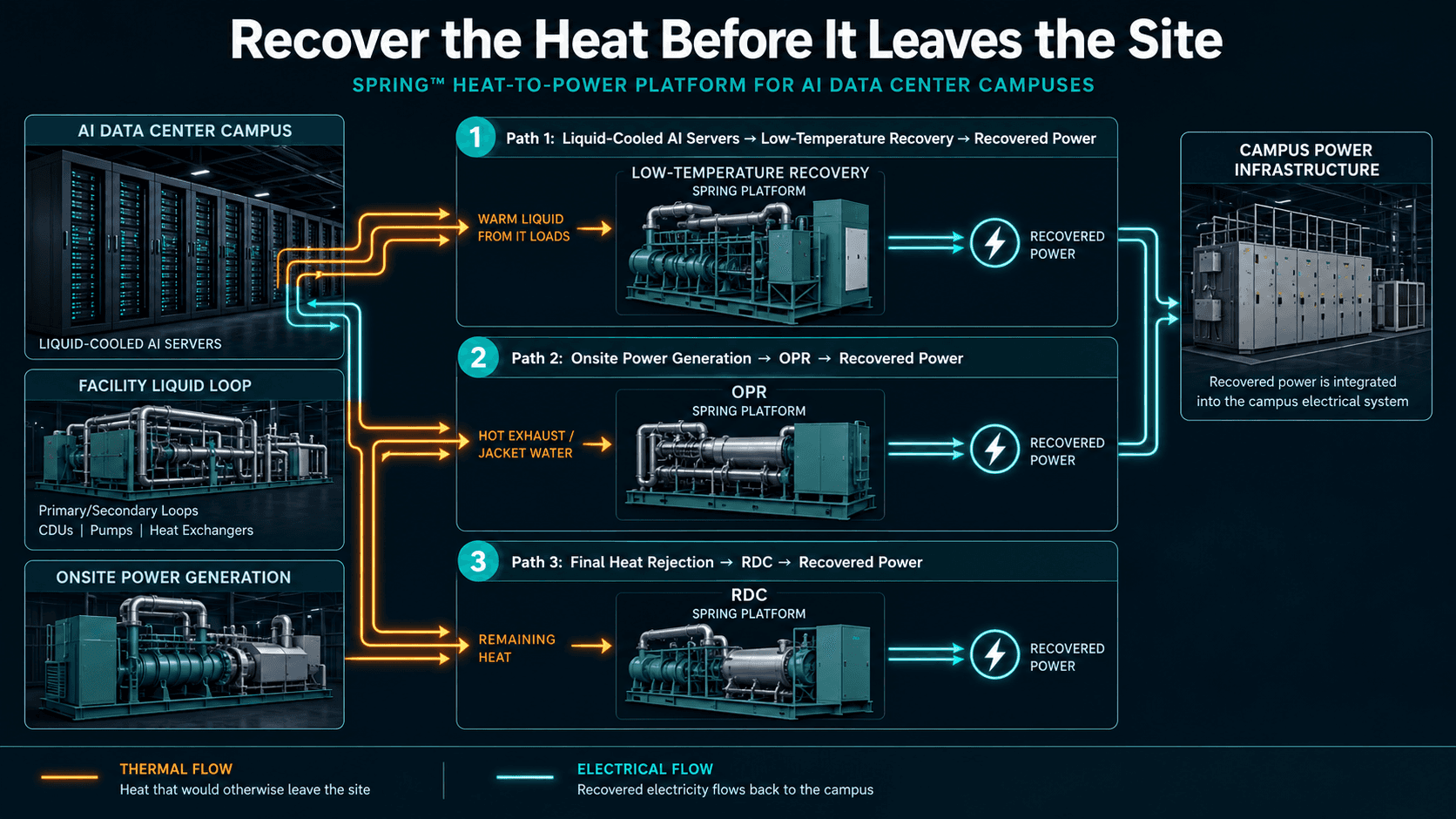
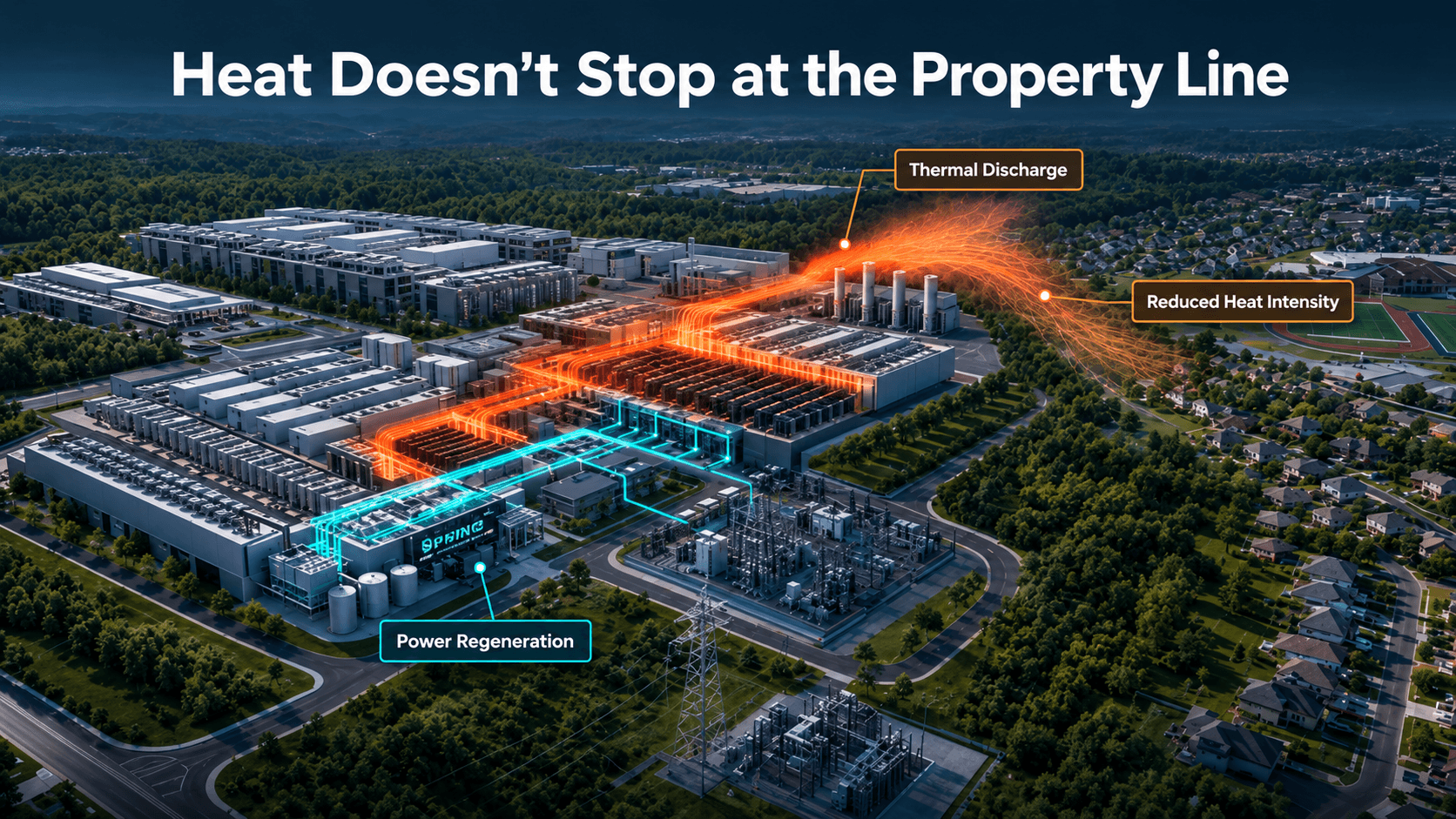
In simple terms: SPRING sits between a facility's hot exhaust or cooling stream and the point where that heat would otherwise just be dumped into the air. It captures that heat and turns it into electricity — and only after that conversion does it release what's left. Most importantly, it rejects the remaining heat at a temperature much closer to the outdoor air than to the original stream. This is a natural by-product of the system’s thermal conversion cycle. Nothing about a facility's servers, engines, or turbines needs to change; SPRING sits downstream of them, intercepting the heat before it's discharged. By minimizing the temperature of the rejected heat, SPRING can substantially mitigate the heat island effect.
Matched to where the heat comes from
Low-temperature recovery by a SPRING Liquid Loop Regenerator (LLR) handles the continuous, lower-temperature heat coming off liquid-cooled server loops, running independently of whether an outside customer exists for the recovered heat.
Onsite Power Recovery (OPR) intercepts the much hotter exhaust and cooling heat coming off engines, turbines, and fuel cells — the exact heat source behind situations like Memphis — and turns a portion of the heat into electricity.
A third configuration, regenerative dry cooling (RDC), applies the same idea to a facility's final cooling step at even lower temperatures than liquid-cooled server loops, without adding a continuous water dependency.
For the largest, gigawatt-scale campuses, these can work together — at the power island, at the server-cooling loop, and at final heat rejection — all pointed at the same goal: less heat, and cooler heat, leaving the property line.
Where this matters most
The benefit isn't uniform across every site. It matters most where thermal density, human exposure, climate stress, or permitting sensitivity is already high:
Gigawatt-scale AI campuses, especially those generating power onsite
Dense urban or infill sites, close to homes, workplaces, and public space
Heat-vulnerable communities — older populations, outdoor workers, limited tree canopy, limited access to cooling
Hot-climate and heat-wave regions, where background temperatures already constrain conventional heat rejection
Locations with persistent nighttime urban heat, where buildings and pavement release stored heat after dark
Water-constrained regions, where a dry heat-rejection pathway is strategically important
High-density data center corridors, where cumulative heat from multiple, individually-compliant facilities adds up at a portfolio scale
Any permitting-sensitive project where a credible, documented heat-mitigation strategy can materially strengthen environmental review and community engagement
What we're not claiming
Near ambient doesn't mean zero heat. SPRING lowers the intensity and temperature of the discharge; it doesn't make the energy disappear.
To assess the exact neighborhood impact, detailed studies — including CFD (computational fluid dynamics) modeling — are recommended.
This is thermal mitigation, not emissions control, and the two should be evaluated and substantiated separately.
The bottom line
The science on data center heat has moved, in the space of about a year, from anecdote to peer-reviewed, cited research — from ASU's ground-level field measurements in Phoenix to a Cambridge-led team's global satellite analysis spanning thousands of facilities. At the same time, the politics have moved just as fast: a majority of Americans now say they oppose data centers in their own area, tens of billions of dollars in projects are getting blocked or delayed, and national political committees are treating it as an electoral issue.
Data centers reject heat from two places — the servers themselves, and increasingly, the onsite power generation built to feed them. SPRING is built to recover useful electricity from both, and to reject what's left over much closer to the temperature of the air around it, rather than well above it, substantially mitigating the impact.
If you're planning a site where thermal discharge, permitting timelines, or community engagement are on the table, we'd like to talk about what a site-specific heat balance looks like for your project.
About
Let’s Talk

Assess Your Data Center Waste Heat Reuse Opportunity
We analyze your facility to quantify power recovery, efficiency gains, and integration opportunities.
Explore SPRING Pilot Programs
Get in touch to evaluate a pilot and validate performance in your environment.

104 West 40th Street, New York, NY 10018