
Myths About Power Regeneration from Low Temperature Heat
Data center energy strategy is entering a different phase.
The old objective was straightforward: improve efficiency, lower cooling overhead, and reduce waste around the compute load. That work still matters. But in today’s market, this is no longer enough.
As AI infrastructure pushes rack density higher, power availability becomes harder to secure, and thermal systems carry more strategic weight, the industry is being forced to think beyond optimization. The more important question now is not only how to use energy more efficiently, but how to recover more value from the energy already moving through the site.
That is where the shift begins.
The next phase of data center energy will be defined less by incremental efficiency gains alone and more by how intelligently operators connect power, cooling, heat recovery, and capacity creation into one infrastructure strategy.
The Original Problem Was Real
Low-temperature waste heat has historically been viewed with skepticism in power recovery discussions, and that skepticism usually came from three core beliefs.
Power cannot be generated at these temperature levels at all.
Even if power could be generated, the efficiency would be too low to matter.
Even if some power output were possible, the economic value would be too limited to justify the required investment.
Those beliefs did not appear out of nowhere. They were shaped largely by the limits of conventional waste heat-to-power technologies, especially Organic Rankine Cycle, or ORC, systems and similar approaches.
These systems generally performed best when they had:
Higher Source Temperatures
Very Stable Operating Conditions
Predictable Steady-State Heat Input
In practice, ORC systems were usually much better suited to hotter and more stable thermal environments. At lower temperatures, efficiency often dropped dramatically, economics became harder to justify, and variable thermal input made performance impractical.
That history mattered, but the market drew the wrong conclusion from it.
What was really true was that a specific technology family struggled with low-temperature and variable heat. What the market often assumed was that low-temperature waste heat itself was not a viable category for power recovery.
The Market Turned a Technology Limitation Into a Category Assumption
This is where the original assumptions became myths.
Power cannot be generated from low-temperature waste heat → That claim no longer holds as a blanket statement. New advanced technologies make this feasible now. The more accurate question is not whether power generation is possible in principle, but whether the economics of the deployment pencil out.
Efficiency limits automatically make low-temperature power recovery unattractive → That framing is too simplistic. Efficiency compared with high-temperature systems may indeed be lower, but efficiency alone is not the critical metric. What matters more is the cost of the power produced (LCOE) and the value of that power within the facility or local power market.
The economics will always be weak because the output is limited → The economics are a function of the value of the power generated. The value of power is a combination of factors:
(a) the production cost relative to marginal cost of power
(b) reliability and whether its predictable
(c) whether it follows the load (demand responsive)
(d) if it displaces other more expensive power sources (capex displacement)
(e) if it reduces risk and enhances plant uptime
(f) if it helps with compliance, permitting and emissions, among other factors..
That is why the old conclusion no longer holds in the way the market often assumed.
That distinction matters even more now because modern data centers are not operating under the same technical and economic assumptions that shaped earlier industrial waste heat recovery thinking.
Data Centers Are Producing Different Heat Conditions Now
Modern data centers are no longer low-density server environments with diffuse thermal output and relatively modest power value per megawatt.
Three shifts matter here.
1. Rack Densities Are Rising Fast
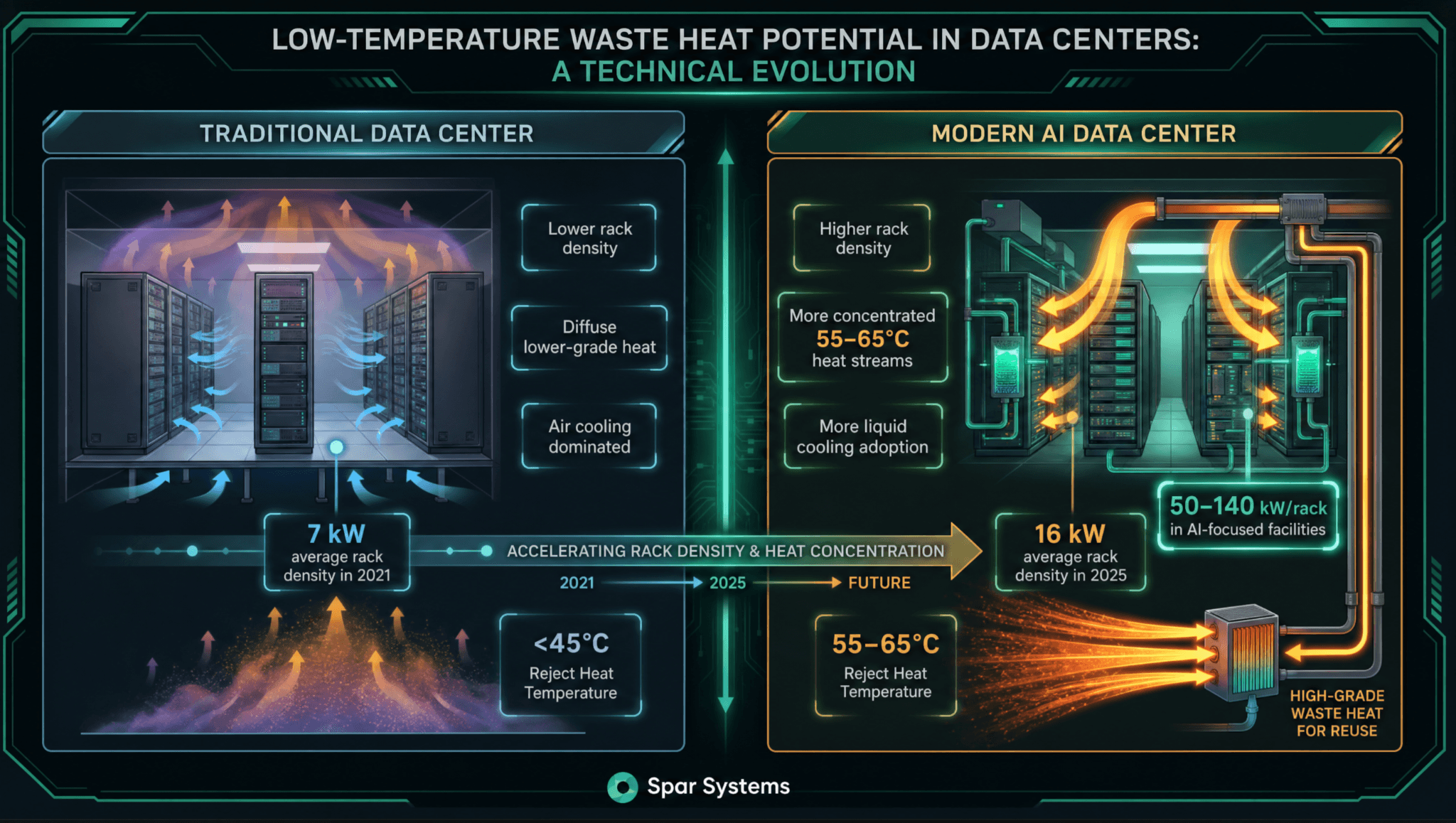
AI workloads are pushing facilities into a very different thermal regime than the industry was used to in the past. Average rack density has increased sharply in recent years, while AI-focused environments are already operating far above traditional levels. That matters because higher-density facilities produce more concentrated thermal output.
2. Liquid Cooling Is Changing the Thermal Stream
Liquid cooling is also changing the character of the heat itself. As liquid cooling becomes more common, thermal output becomes more concentrated, more structured, and in many cases hotter than the conditions that shaped older assumptions. WHP enhances the ROI on investments in liquid cooling and is a natural complementary technology.
3. The Value of Each Megawatt Is Much Higher Now
The economics have changed as well.
A usable megawatt inside a modern data center carries much more strategic value than it ever did. That shift is being driven not only by data center growth, but also by broader grid pressure from electrification, industrial demand, and rising load across multiple sectors.
In that environment, recovering useful value from thermal output matters more than it used to.
That is why low-temperature waste heat needs to be evaluated under modern data center conditions. The heat is becoming more concentrated, more accessible, and more valuable to recover because the power it can offset or support is itself more valuable than before.
The Cooling Market Itself Shows the Scale of the Waste
The market is already spending heavily to manage this heat.
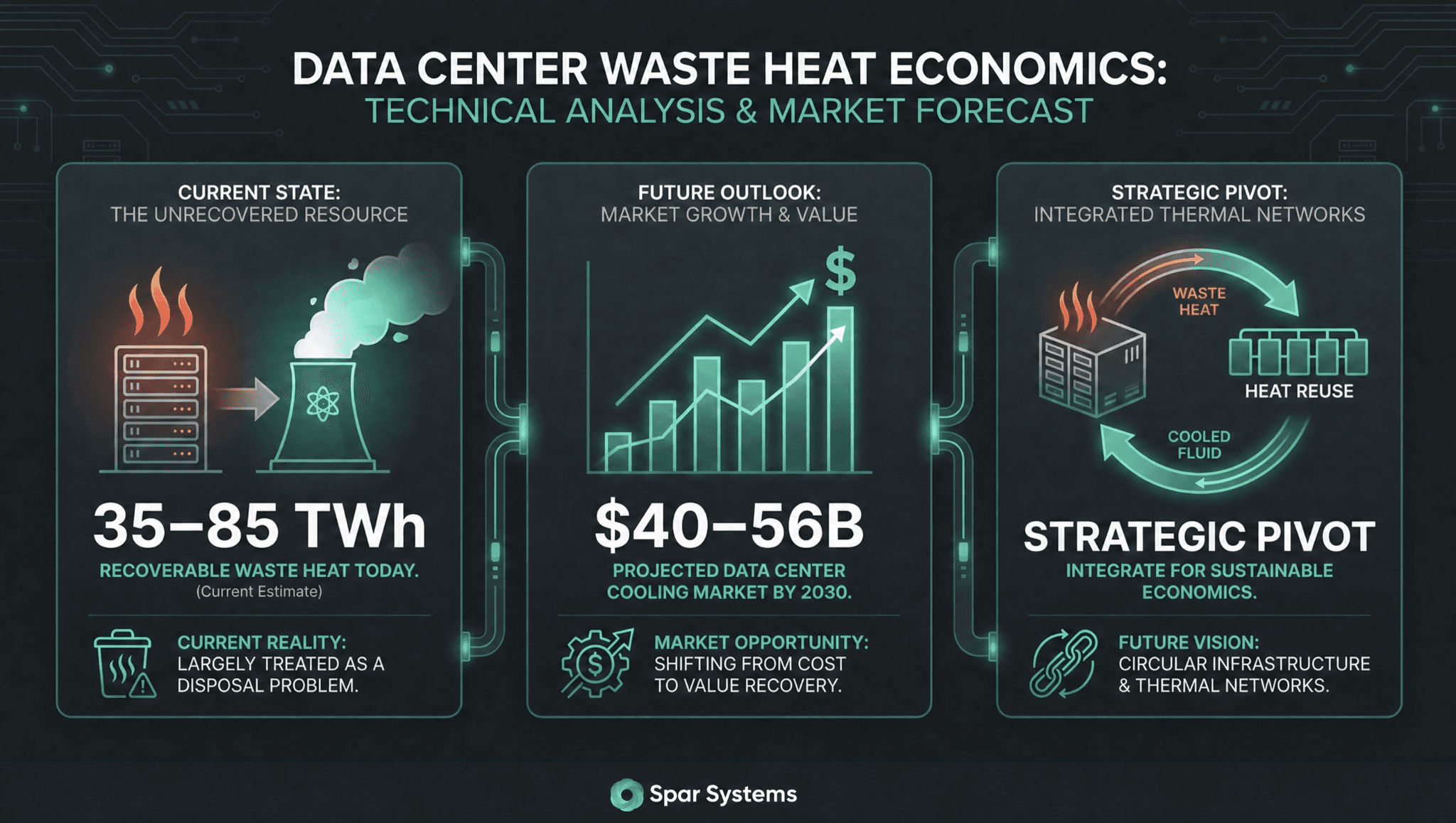
TAM analysis estimates that the data center cooling market could reach $40–56 billion by 2030. At the same time, academic estimates cited in the same materials suggest 35–85 TWh of recoverable data center waste heat already exists today.
That is why this topic deserves a more careful look.
The industry is building a large market around removing energy that may still hold infrastructure value. That does not mean every thermal stream is economic to recover. It does mean the industry should be more precise before dismissing low-temperature heat as a category.
The More Useful Industry Question
The market does not need a bigger debate around whether low-temperature heat is “possible” in the abstract.
The more useful question is this:
Do operators now have a practical and economical way to recover value from low-temperature waste heat under real data center conditions?
That is where Spar’s SPRING system becomes important. It is designed to make waste heat to power practical and economic at data center temperatures, which changes the discussion from a broad technical objection to a real infrastructure question.
That is the question operators, planners, investors, and infrastructure teams should be asking now. And it is a better question than the myth it replaces.
————————————————————————————————————————
References
1) IEA – Energy and AI (for data center electricity demand, grid pressure, broader industry shift)
https://www.iea.org/reports/energy-and-ai/executive-summary
2) Lawrence Livermore National Laboratory – Estimated U.S. Energy Consumption in 2023
(for the 18,024 TWh U.S. waste heat / rejected energy reference)
https://flowcharts.llnl.gov/sites/flowcharts/files/2024-10/energy-2023-united-states.pdf
3) Vertiv + Dell – Modernizing Federal IT with AI-Ready Modular Data Centers
(for average rack density around 15 kW in 2024 and some AI deployments at 100 kW+ per rack)
4) Dell’Oro Group – Data Center Liquid Cooling Market to Approach $7 Billion by 2029
(for liquid cooling becoming a functional requirement in large-scale AI deployments)
5) Research and Markets – Data Center Cooling Market
(for global data center cooling market growth reference)
https://www.researchandmarkets.com/reports/6067380/data-center-cooling-market-comprehensive
About
Let’s Talk

Assess Your Data Center Waste Heat Reuse Opportunity
We analyze your facility to quantify power recovery, efficiency gains, and integration opportunities.
Explore SPRING Pilot Programs
Get in touch to evaluate a pilot and validate performance in your environment.

104 West 40th Street, New York, NY 10018