How the EU Energy Efficiency Directive Is Creating a New Energy Recovery Market
Executive Summary
Artificial intelligence is accelerating the growth of large-scale data centers across Europe and around the world. As power consumption rises, so does the amount of heat generated by computing infrastructure.
Nearly all electricity consumed by servers ultimately becomes heat. Historically, this heat has been treated as a by-product that must be removed through cooling systems and rejected to the environment.
The European Union's Energy Efficiency Directive (EED) is helping change that perspective. Through new reporting requirements and increasing emphasis on waste heat utilization, policymakers are encouraging operators to view waste heat as a recoverable energy resource rather than an unavoidable loss.
While district heating networks are often presented as the primary solution, practical limitations restrict deployment across many data center sites. Waste-heat-to-power (WHP) systems offer an alternative pathway by converting thermal energy directly into electricity that can be used on-site.
As data center power demand continues to rise, technologies capable of recovering value from low-temperature waste heat may play an increasingly important role in improving facility efficiency, reducing energy waste, and supporting compliance with emerging regulations.
The Growth of AI Data Centers
Artificial intelligence workloads are driving a rapid increase in data center electricity consumption.
Modern hyperscale facilities consume hundreds of megawatts of power and are becoming some of the largest single-site electricity users in the global economy.
Global Data Center Electricity Demand
Year | Data Center Electricity Demand |
2022 | ~122 GW |
2030 (Projected) | ~200 GW |
As electricity consumption increases, so does waste heat production.
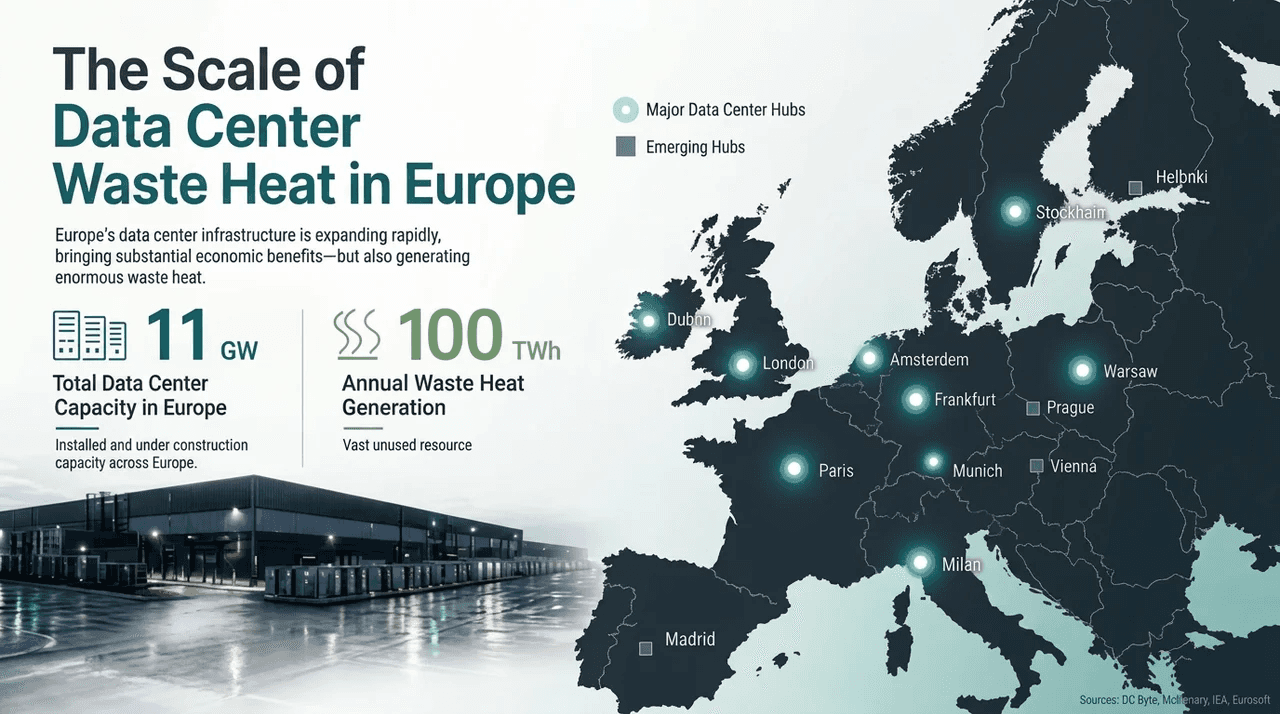
Estimated 2025 Data Center Waste Heat Across the European Union
Metric | Estimate |
Total data center capacity | ~11 GW |
Annual waste heat generation | ~100 TWh |
This represents a significant untapped energy resource that is currently underutilized.
Understanding the EU Energy Efficiency Directive
Europe is moving beyond simply measuring data center energy consumption. Regulators are increasingly requiring operators to recover value from waste heat.
The revised EU Energy Efficiency Directive (EED) requires large data centers to report detailed energy and sustainability metrics, including energy consumption, cooling performance, renewable energy usage, and waste heat recovery opportunities.
Several countries are already implementing requirements that go significantly further.
Germany: Mandatory Energy Reuse Targets
Germany's Energy Efficiency Act (EnEfG) establishes some of the most aggressive data center efficiency requirements in the world.
New data centers entering operation after July 2026 must achieve a minimum Energy Reuse Factor (ERF) of 10%. The requirement increases to:
15% for facilities entering operation after July 2027
20% for facilities entering operation after July 2028
In practice, operators must demonstrate that a meaningful portion of the energy entering the facility is being recovered and reused rather than simply rejected to the environment.
Germany also imposes stringent PUE requirements and renewable electricity obligations, making waste heat utilization an increasingly important component of data center design.
France: Heat Recovery as National Energy Policy
France has made waste heat recovery a central element of its energy transition strategy. Through district heating incentives, permitting frameworks, and national decarbonization programs, data center operators are increasingly expected to evaluate and implement pathways for productive heat reuse.
For many new developments, waste heat recovery is becoming a key consideration in discussions with municipalities, utilities, and local energy network operators.
The Direction of Travel Is Clear
The policy trend across Europe is unmistakable: waste heat is no longer viewed as a disposal problem. It is increasingly being treated as an energy resource.
As AI workloads drive unprecedented growth in electricity demand, regulators are increasingly focused on extracting additional value from every megawatt entering a facility. Data centers that can recover energy, reduce net grid demand, and contribute to local energy systems are likely to be better positioned for permitting, compliance, and long-term competitiveness.
Why District Heating Is Not Always Practical
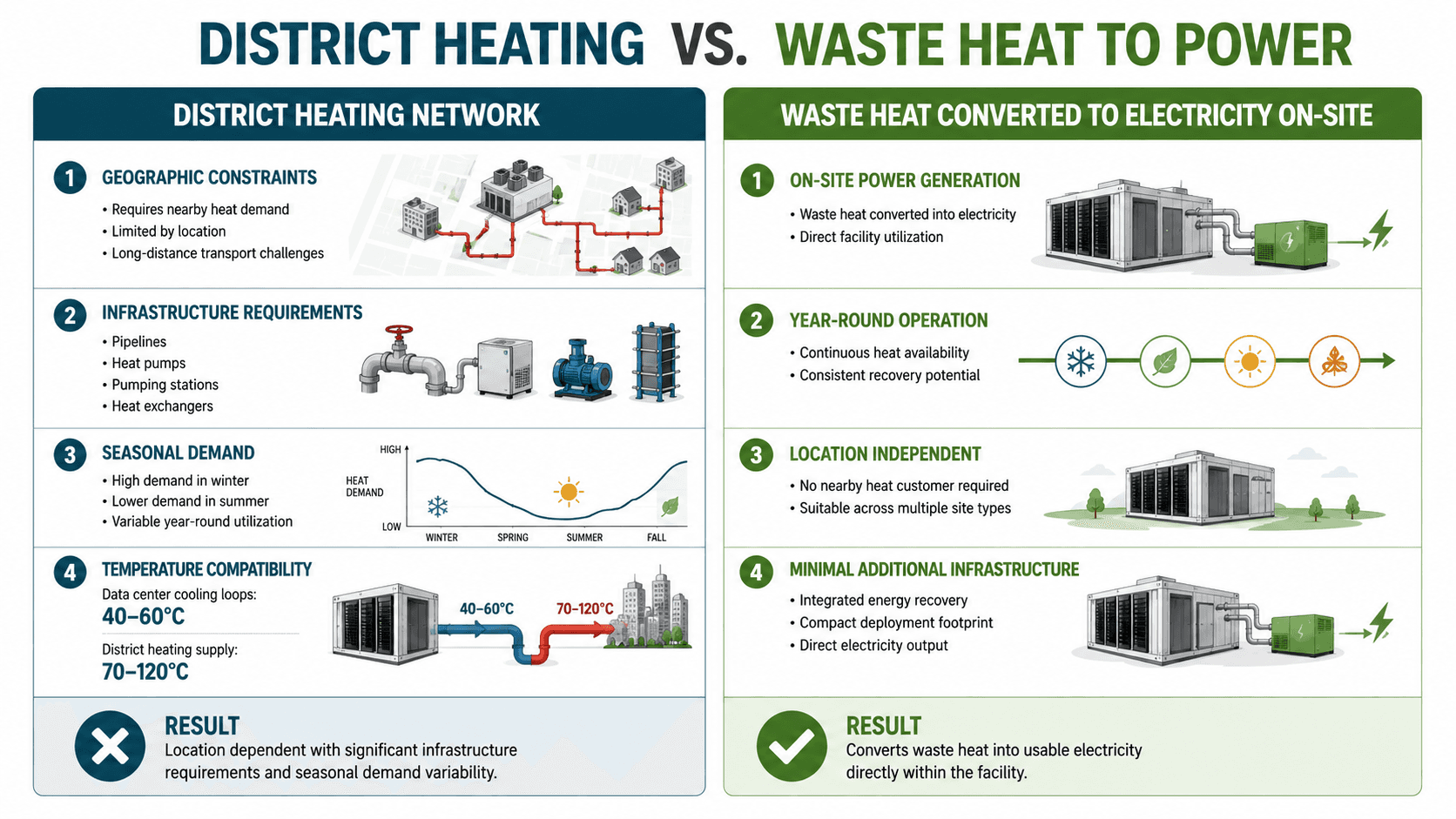
District heating networks are often discussed as the primary mechanism for utilizing data center waste heat.
While district heating can be highly effective in certain locations, several practical challenges limit widespread deployment.
Geographic Constraints
District heating infrastructure exists primarily in specific urban regions.
Many data centers are located outside these areas, making direct integration difficult or impossible.
Infrastructure Requirements
Connecting a facility to a district heating network often requires significant investment in:
Pipelines
Heat Pumps
Pumping stations
Heat exchangers
Distribution infrastructure
Pipeline costs alone can often range between €1 million and €5 million per kilometer.
Seasonal Demand
District heating demand is highly seasonal.
Heat demand is typically highest during winter and significantly lower during summer months.
Data centers, however, generate heat continuously throughout the year.
Temperature Compatibility
Typical temperature ranges often differ substantially:
System | Temperature Range |
Data center cooling loops | 40–60°C |
District heating supply | 70–120°C |
These factors mean district heating can be an excellent solution in some cases, but it is not universally applicable.
Waste Heat to Power as an Alternative Pathway
An alternative approach is converting waste heat directly into electricity.
In a waste-heat-to-power system, heat energy from cooling infrastructure drives a thermodynamic cycle that generates electrical power.
This approach offers several advantages:
Location independence
Continuous year-round operation
No external heat distribution infrastructure
Direct on-site electricity generation
Unlike district heating, electricity can be used regardless of season or local heating demand.
Because electricity is the most flexible form of energy, facilities can recover value from heat streams that would otherwise be discarded.
The Current Technology Landscape
Several technologies exist for converting heat into electricity.
However, most commercial solutions operate efficiently only at relatively high temperatures.
Technology | Typical Temperature Range |
Organic Rankine Cycle (ORC) | >90–120°C+ |
Kalina Cycle | >120°C |
Thermoelectric Systems | Low efficiency, limited scalability |
As a result, many low-temperature heat streams generated by data centers remain economically difficult to utilize using conventional approaches.
This creates a significant gap between available waste heat and recoverable energy.
Spar Systems Technology
Spar Systems has developed a waste-heat-to-power system designed specifically for ultra-low-temperature heat sources.
Key characteristics include:
Operation with heat sources as low as approximately 40°C
Integration with liquid cooling environments
Electricity generation from low-grade thermal energy
Support for on-site energy recovery
Recovered electricity can be used to support:
IT infrastructure
Cooling systems
Auxiliary facility loads
Other electrical equipment
By converting previously discarded heat into usable electricity, facilities can improve overall energy utilization while reducing waste.
How Waste Heat to Power Aligns with the EED
Waste-heat-to-power systems support several objectives of the Energy Efficiency Directive.
Continuous Energy Recovery
Energy can be recovered throughout the year without depending on seasonal heating demand.
Universal Applicability
Systems can be deployed regardless of proximity to district heating infrastructure.
Energy Fungibility
Electricity can be used directly within the facility to support operations.
Reduced Infrastructure Requirements
No extensive heat distribution networks are required.
These characteristics make waste-heat-to-power an attractive complement to broader waste heat utilization strategies.
Economics Per Data Center
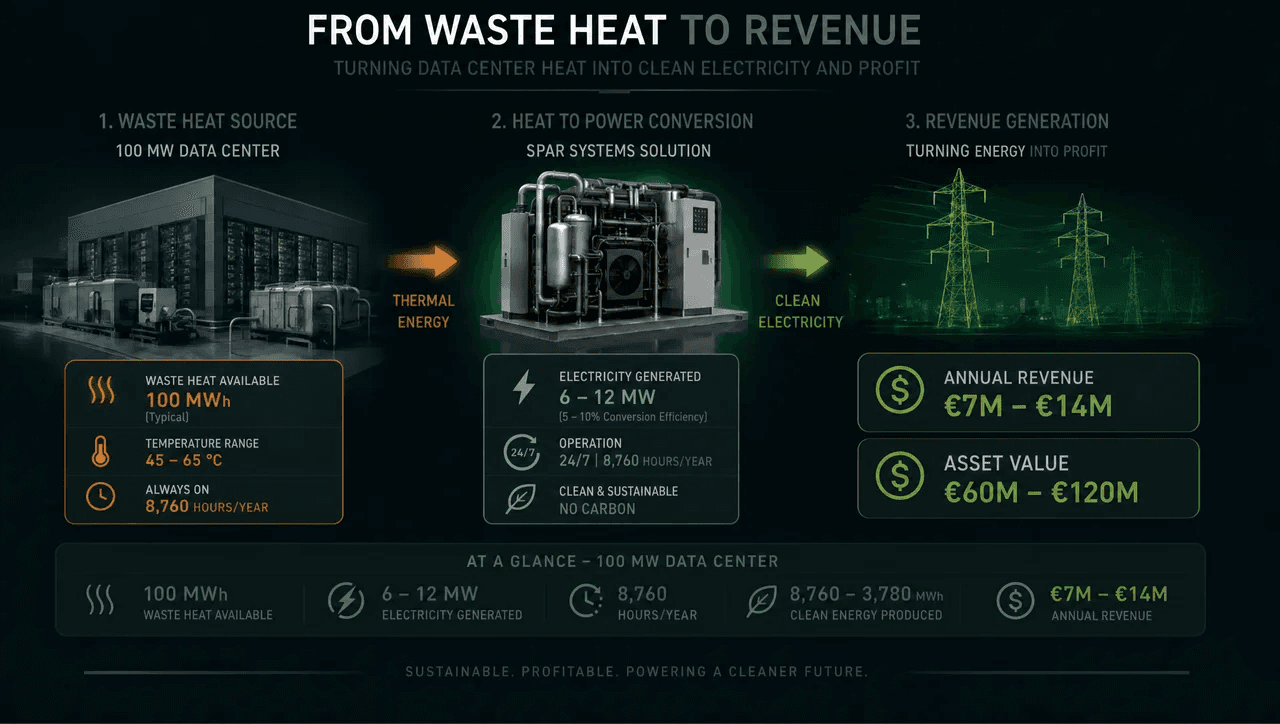
Consider a 100 MW data center producing approximately 100 MW of thermal waste heat.
Assume the following heat-to-power conversion scenarios:
Electric Output | Annual Electricity Generation |
5 MW (5%) | ~43,800 MWh |
10 MW (10%) | ~87,600 MWh |
Representative European Electricity Prices
Country | Electricity Price |
Germany | €120–180/MWh |
France | €90–140/MWh |
Netherlands | €100–160/MWh |
Using €140/MWh as a representative value:
Annual Revenue Potential
Output | Annual Revenue |
5 MW | ~€6.1M |
10 MW | ~€12.3M |
Revenue Potential Over a 20-Year PPA
Output | Lifetime Revenue |
5 MW | ~€120M |
10 MW | ~€245M |
Assuming a 10x valuation multiple on long-term contracted revenue streams, this could imply project asset values ranging from approximately €60 million to €120 million per 100 MW_thermal deployment.
Assumption note: This valuation estimate uses a 10x multiple on potential long-term contracted annual revenue. The multiple is illustrative and based on the type of recurring, infrastructure-backed revenue that may be created when waste-heat-to-power systems are contracted over long operating periods.
While actual economics will vary by location, electricity pricing, and system configuration, the scale of the opportunity illustrates why energy recovery is attracting increasing attention.
Conclusion
The European Union Energy Efficiency Directive is helping reshape how operators think about waste heat.
Historically viewed as an unavoidable by-product, waste heat is increasingly being recognized as a recoverable energy resource with measurable economic value.
District heating will continue to play an important role where conditions allow. However, many facilities face geographic, seasonal, and infrastructure constraints that limit practical deployment.
Waste-heat-to-power systems offer an alternative pathway by converting thermal energy directly into electricity that can be used within the facility.
As AI infrastructure continues expanding and energy demand grows, technologies capable of recovering value from low-temperature waste heat will become an increasingly important part of the future data center energy ecosystem.
————
References
https://www.iea.org/reports/energy-and-ai/energy-demand-from-ai
https://www.eudca.org/documents/content/5qLZNpx-Sw-8IBvavG1CHgo39?download=0
https://www.sciencedirect.com/science/article/pii/S1364032125005362
About Spar Systems
Spar Systems develops waste-heat-to-power infrastructure that converts low-temperature waste heat into usable electricity.
The company's technology is designed to unlock additional value from thermal energy streams generated by data centers, industrial facilities, and on-site power systems.
Learn more: https://www.sparsystems.com
Contact: info@sparsystems.com
About
Let’s Talk

Assess Your Data Center Waste Heat Reuse Opportunity
We analyze your facility to quantify power recovery, efficiency gains, and integration opportunities.
Explore SPRING Pilot Programs
Get in touch to evaluate a pilot and validate performance in your environment.

104 West 40th Street, New York, NY 10018