
Financing Waste Heat Power Regeneration for Data Centers: Near Zero-CapEx Models
Waste heat to power (WHP) in data centers is not only a technical opportunity. It is also a financing question. The real issue is not simply who pays upfront, but how the project fits into real capital planning, cooling infrastructure replacement cycles, and available incentive structures. In the right model, part of the cost can be offset by displacing dry cooler or evaporative cooler capex, while government incentives reduce the remaining burden. That is what can make net capex approach zero and turn WHP from an add-on into a core infrastructure decision.
Waste heat to power (WHP) in data centers is often discussed as a technical opportunity. In practice, adoption is just as much a financing question.
The challenge is not simply whether waste heat can be converted into useful on-site power. The more important question is how the project fits into real data center capital planning, equipment replacement cycles, and infrastructure approval processes.
That is where the financing discussion becomes more specific than many people assume.
For data centers, WHP does not have to be evaluated as a completely new standalone capital burden. In the right structure, it can be financed in a way that reflects two realities:
part of the project can displace capex that would otherwise be spent on conventional heat rejection systems such as dry coolers or evaporative coolers
the remaining cost can be reduced materially through public incentives, tax credits, and other government-backed support mechanisms
That changes the commercial conversation substantially.
Instead of asking whether operators will approve a new layer of expensive infrastructure, the better question is whether they can adopt a system that replaces part of the conventional cooling stack, unlocks additional value from waste heat, and do so with a much lower net capital burden.
Why Financing Needs to Be Framed Differently
In many infrastructure categories, a financing discussion starts with a simple question: who pays upfront?
For data center waste heat power, that framing is too narrow.
The more relevant starting point is this: what existing infrastructure spend can be displaced, and what external incentives can reduce the remaining capex?
That distinction matters because the economics of a WHP system are not based only on electricity generation. They are shaped by how the system fits into the broader thermal and capital architecture of the site.
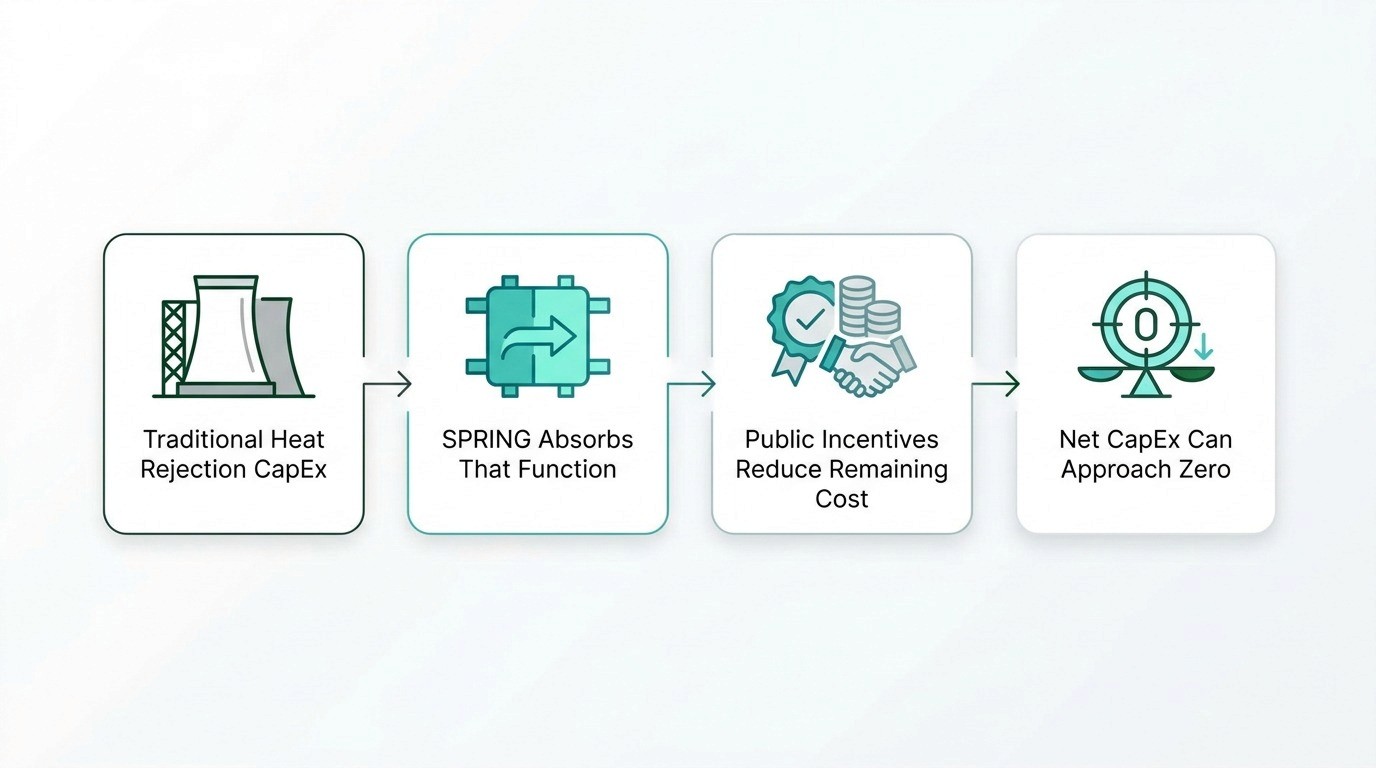
If a system replaces or absorbs the function of conventional heat rejection infrastructure, then some of the capital that would have gone to dry coolers or evaporative coolers is no longer separate. It becomes part of the new system economics.
And if public incentives are available on top of that, the net project capex can decline sharply.
That is the real commercial starting point.
PPA Models
A Power Purchase Agreement can be useful when the operator wants the benefit of the system without taking on the full capital commitment directly.
In a PPA structure, a third party finances and owns the system, and the site pays for the power or performance output under contract.
That can be attractive for data center operators because it shifts the conversation from equipment purchase to service or energy procurement. It can reduce internal friction, especially when the organization wants predictable commercial terms rather than direct asset ownership.
A PPA model works best when:
the operator wants limited upfront capital exposure
the site can support a long-term contracted structure
the commercial value of the recovered power is clear
ownership of the asset is less important than access to the output
For WHP, the benefit of a PPA is not just financial flexibility. It can also help align the project with a more familiar infrastructure-buying framework, which often makes internal approval easier.
Public Incentives Can Change the Capex Equation
This is the part that often gets missed.
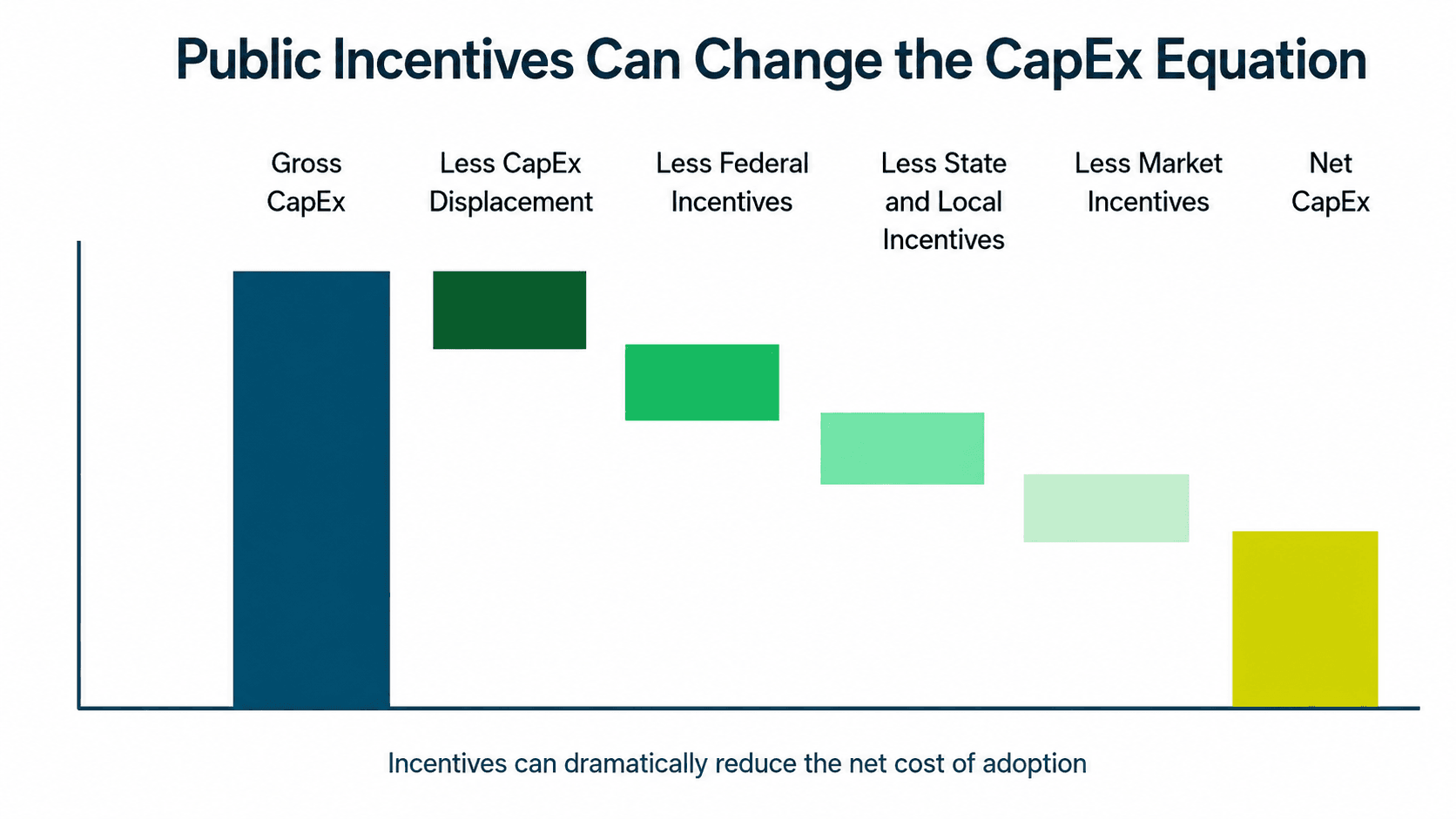
The commercial case is not fundamentally about stacking a long list of loosely related benefits. It is more directly about the fact that public incentives can change the capex equation in a major way.
When a project qualifies for government-backed incentives, credits, or support mechanisms, the remaining capital burden can decline sharply. That can move a project from “interesting” to “attractive.”
The commercial logic is strongest when three things come together:
conventional cooling capex is displaced
public incentives reduce remaining project cost
the site still captures the operational value of on-site waste heat recovery
Incentives Can Dramatically Reduce WHP Deployment Cost
A major reason WHP can become commercially very attractive is that waste-heat recovery and clean electricity projects may qualify for multiple incentive programs, especially in the U.S.
These incentives can reduce project cost in several ways:
Federal incentives: WHP projects may qualify for U.S. clean electricity support such as §48E investment tax credits or §45Y production tax credits, depending on project structure, ownership, and eligibility. This can reduce capex about 30%
Bonus adders: Some projects may also benefit from domestic content or energy community adders, which can increase the value of federal tax credits. These can enable another 10-20% capex reduction.
State and utility programs: State tax exemptions, utility energy efficiency rebates, demand reduction value, and local incentive programs can further improve the economics. Various programs offer rebates and tax incentives.
Carbon Credits and RECs: WHP may also qualify for carbon credits and Renewable Energy Certificates in some jurisdictions, further creating monetizable assets for the project owner.
Transferable credits: In some cases, tax credits may be transferable, helping projects monetize incentives even when the project owner cannot use the full credit directly.
Global incentive pathways: Outside the U.S., WHP may also benefit from grants, operating subsidies, concessional financing, carbon credit systems, and national energy efficiency programs.
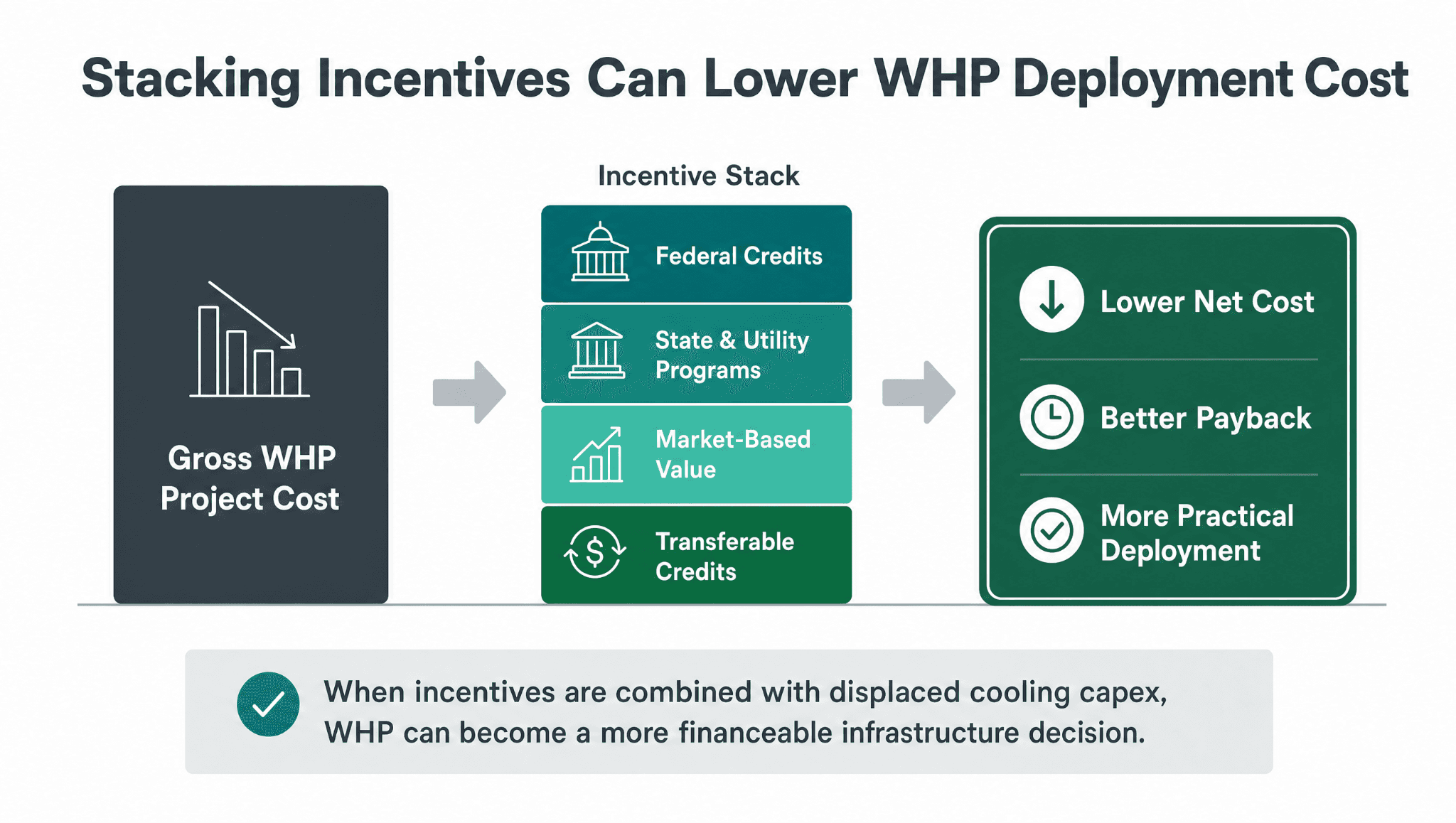
Importantly, incentives are often stackable. Federal, state, utility, and market-based support can work together to reduce the remaining capital burden.
This changes how WHP should be evaluated. It should not be viewed only as a standalone equipment cost. When incentive support is combined with displaced dry cooler or evaporative cooler capex, the net deployment cost can fall dramatically.
For example, in Loudoun County, VA, a WHP implementation may qualify for:
§48E investment tax credits (30-50%)
Virginia data center sales tax exemption (~5-6%)
Dominion Energy (utility) - Energy Efficiency rebates (~5-15% of capex)
PJM capacity avoidance benefit
Carbon credits
Zero-CapEx Should Be Understood as Net CapEx Near Zero
In this category, zero-capex should not be understood only as “someone else pays upfront.” The more accurate meaning is that the net capex can approach zero because the project is not starting from a blank sheet.
Part of the capital requirement can already be offset by the fact that the system absorbs functions that would otherwise require conventional heat rejection equipment. Additionally, public incentives can reduce the remaining project cost further substantially.
So the model becomes:
displace conventional cooling-related capex
apply available public incentives
reduce net project capex materially, in some cases close to zero
It is zero-capex or near-zero-capex in the sense that existing planned infrastructure spend and external incentives can dramatically reduce the net cost of adoption.
Where SPRING Fits In
This is where Spar’s SPRING system becomes important.
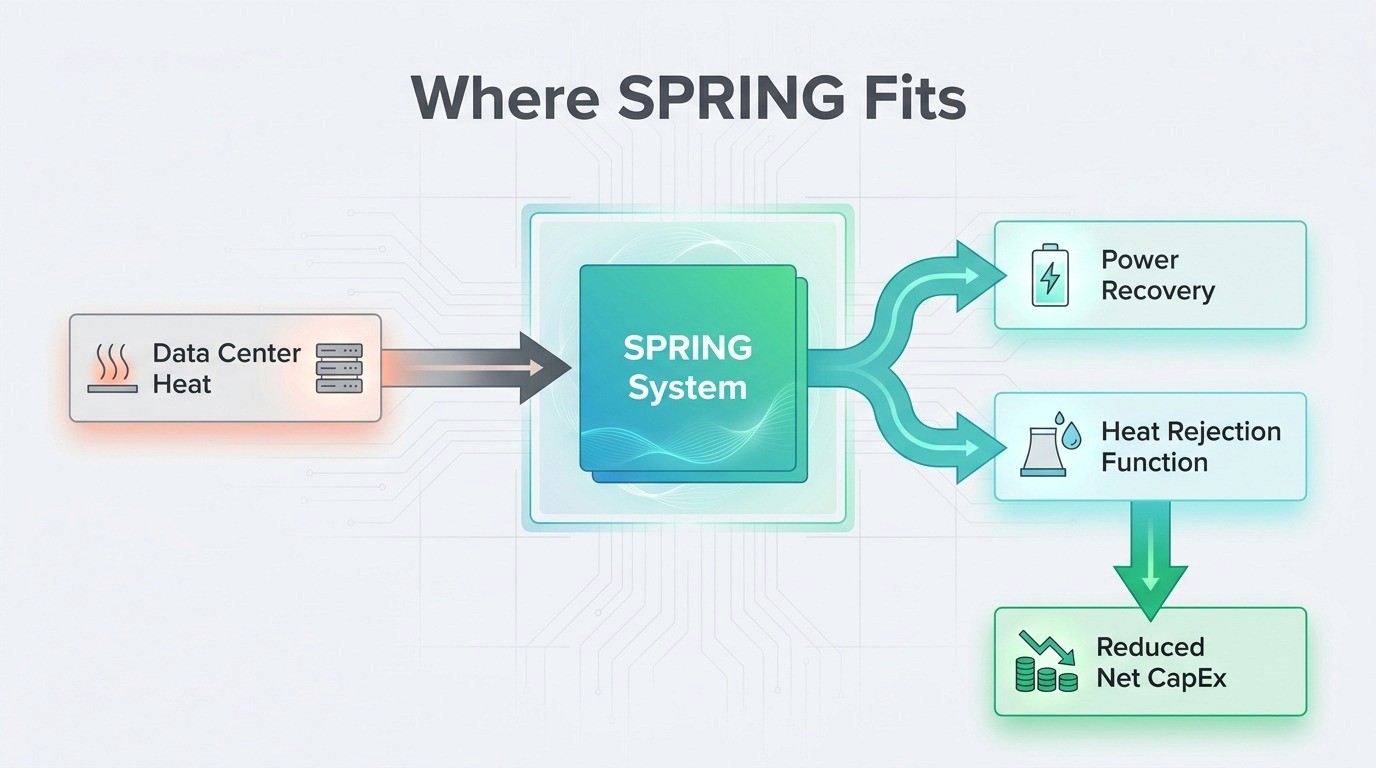
The commercial model works because SPRING is not just another add-on generation layer. It changes the practicality of the category by integrating waste heat recovery into the data center’s thermal and infrastructure design in a way that can absorb the role of conventional heat rejection equipment.
That is what makes the financing discussion more compelling.
If the system can both:
perform the required thermal role
and enable economical waste heat power recovery
then the project is no longer being judged as a separate “extra” technology. It becomes part of a more integrated infrastructure solution.
That is also why the financing structures discussed above are relevant. PPA and IPP models can help align ownership and operating responsibility. But the most important commercial insight is that SPRING can change the net capital equation itself.
That is what makes zero-capex or near-zero-capex a serious financing discussion rather than a theoretical one.
About
Let’s Talk

Assess Your Data Center Waste Heat Reuse Opportunity
We analyze your facility to quantify power recovery, efficiency gains, and integration opportunities.
Explore SPRING Pilot Programs
Get in touch to evaluate a pilot and validate performance in your environment.

104 West 40th Street, New York, NY 10018