Every megawatt is not equal: in data centers, waste heat power should be valued not just as electricity, but as behind-the-meter infrastructure that can reduce cooling capex, grid dependence, emissions, and resilience risk.
Every Megawatt Is Not Equal: Rethinking the Cost of Waste Heat Power
Summary
The cost conversation around waste heat power is often framed too narrowly.
Most comparisons ask a simple question: How does the levelized cost of electricity from waste heat power compare with grid power, solar, wind, or gas?
That question is useful, but incomplete.
In data centers, every megawatt is not equal. Some megawatts are more valuable because of where they are produced, when they are available, whether they are firm, whether they are behind the meter, whether they follow the load, whether they reduce emissions, and whether they displace more expensive infrastructure elsewhere on the site.
That is why waste heat power (WHP) should not be evaluated only as another source of electricity.
In the right data center architecture, WHP can also reduce cooling and heat rejection capex, reduce dependence on constrained grid supply, improve resilience, and make better use of thermal energy that would otherwise be rejected.
The better question is not simply:
What does this megawatt cost?
The better question is:
What is this megawatt worth inside the actual data center architecture?
That distinction matters enormously.
Why Standard Cost Comparisons Miss the Point
Levelized cost of electricity is a useful metric.
It compares the lifetime cost of a power asset against the electricity it produces. For conventional generation assets, the logic is straightforward:
• Capital cost
• Operating cost
• Fuel cost
• Financing cost
• Lifetime output
• Resulting cost per megawatt-hour
That framework works reasonably well when comparing stand-alone power sources. It is useful for comparing solar against wind, gas against grid power, or one generation project against another.
But it becomes less complete when the power source is integrated directly into the facility itself.
Waste heat power is not a remote generation asset. It does not begin with a separate fuel source or a separate generation site. It begins with heat that already exists inside the data center.
That heat must be managed regardless. It must be moved, rejected, or reused. The facility is already spending capital and energy to deal with it.
That makes waste heat power fundamentally different from a stand-alone power plant.
A narrow LCOE comparison treats waste heat power as if it were only an electricity generator. But in a data center, waste heat power may also interact with the cooling loop, heat rejection equipment, peak power requirements, backup infrastructure, and site-level resilience strategy.
Ignoring those effects understates the value of the recovered power.

Every Megawatt Is Not Equal
A megawatt is not just a megawatt.
A megawatt delivered at the wrong time, in the wrong place, or with the wrong reliability profile may be far less valuable than a megawatt that directly supports the site when and where it is needed.
For data centers, the value of a megawatt depends on several questions:
• Is it firm?
• Can the operator count on it?
• Is it behind the meter?
• Does it reduce dependence on grid constraints or interconnection queues?
• Does it improve the marginal emissions profile of the facility?
• Does it follow the site’s load?
• Can it support mission-critical infrastructure?
• Does it displace a more expensive megawatt?
• Can it reduce peak capacity requirements?
These questions matter as much as the headline cost per megawatt-hour.
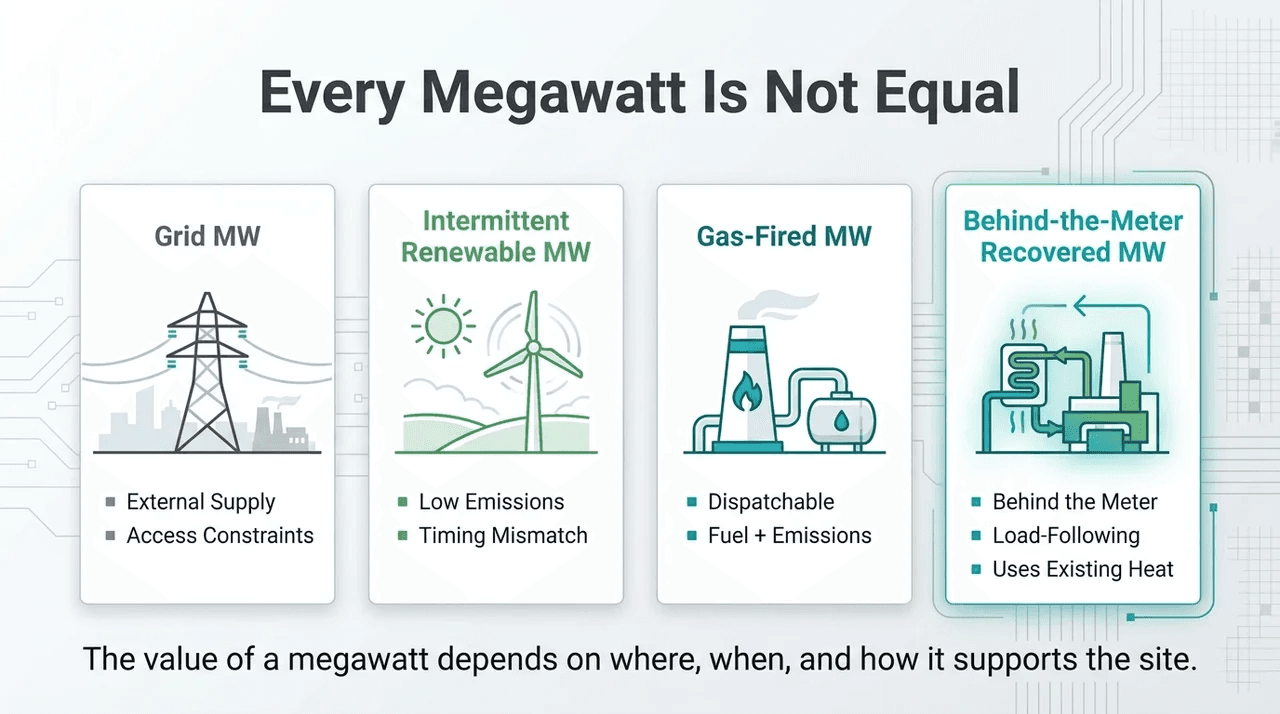
A commodity grid megawatt, an intermittent solar megawatt, a gas-fired megawatt, and a behind-the-meter recovered megawatt may all show up as “MW” in a spreadsheet.
But they do not have the same operational value.
The real cost comparison must reflect that.
Why Data Centers Make This Especially Important
Data centers are unusual energy environments.
They consume large amounts of electricity continuously. They produce large amounts of heat continuously. They spend heavily on cooling infrastructure. They operate in markets where grid access is increasingly constrained.
They also face growing pressure around emissions, resilience, permitting, and speed to market.
In that context, the marginal megawatt is not just a unit of electricity.
It can determine whether a campus can expand, whether servers can be energized, whether backup infrastructure must be upsized, and whether a site can operate within its power envelope.
This is why power in data centers cannot be evaluated only on commodity price.
A megawatt that is available behind the meter, closely matched to the facility’s thermal load, and capable of reducing peak demand may be more valuable than a cheaper megawatt that is intermittent, remote, delayed by interconnection constraints, or unavailable when the site needs it most.
The core issue is simple: The value of power depends on architecture.
Waste Heat Power Starts Inside the Site
Waste heat power is different from grid power, solar, wind, and gas because it starts with energy already inside the facility.
A data center converts nearly all of its electrical input into heat. That heat must be removed to keep IT equipment operating safely.
Traditional infrastructure treats that heat as a liability. It is collected, moved, and rejected into the environment through dry coolers, cooling towers, chillers, or other heat rejection systems.
Waste heat power changes that logic.
Instead of treating heat only as a waste stream, it treats part of that thermal flow as an energy resource. The system captures useful work from heat that would otherwise be rejected.
That does not mean waste heat power replaces all cooling infrastructure. It does not mean it beats every other power source in every case.
But it does mean the economics should be evaluated differently.
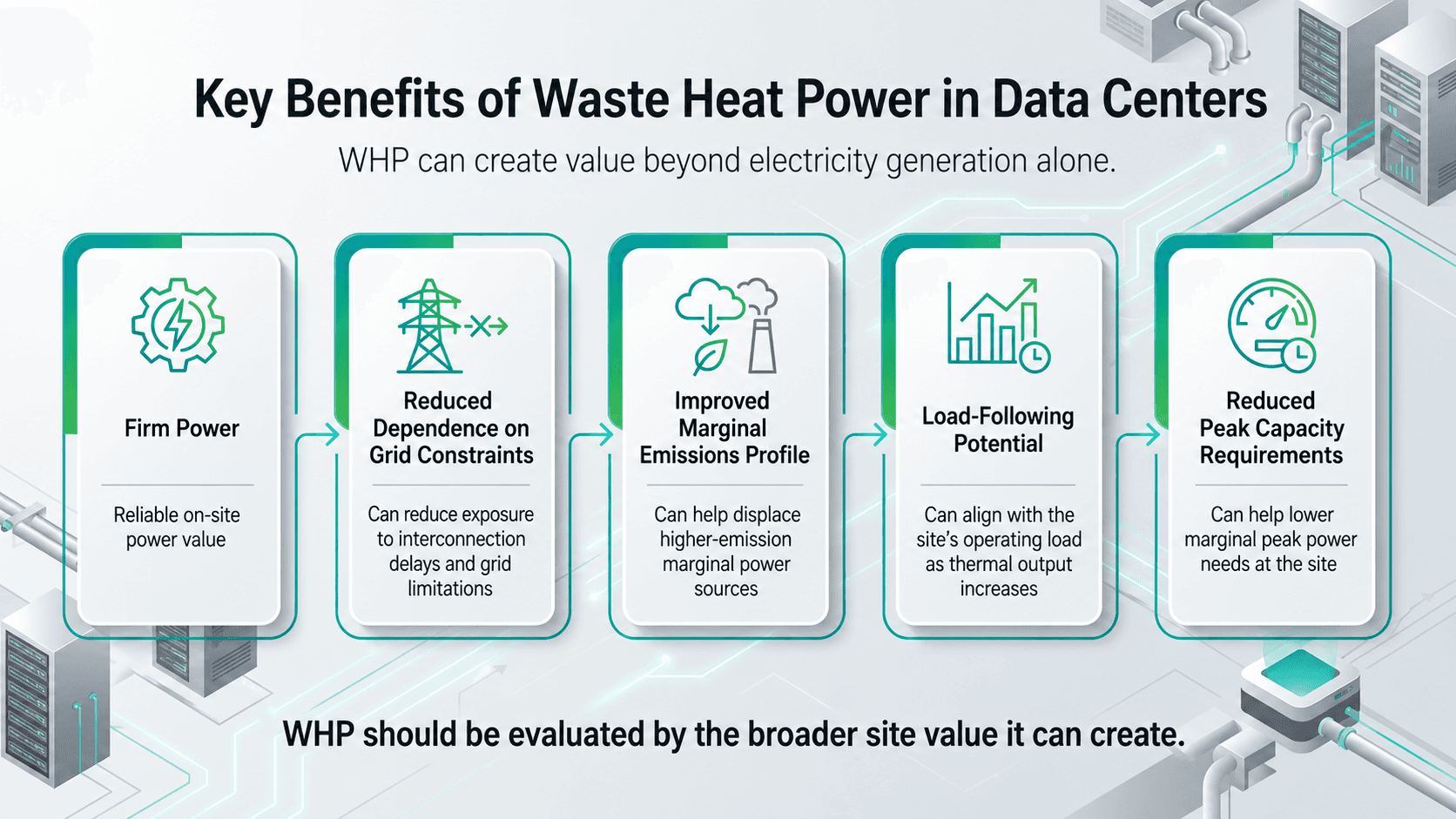
A recovered megawatt from waste heat may have several layers of value at once:
• It produces useful electricity
• It is located behind the meter
• It is naturally linked to the site’s operating load
• It may reduce the burden on conventional heat rejection equipment
• It may reduce the amount of grid or backup infrastructure required to serve the same IT load
• It may improve resilience by adding another layer of on-site electricity
Those attributes are not captured in a simple LCOE comparison.
The Cooling Offset Is Central
One of the most important economic effects is the potential reduction of capex elsewhere in the data center.
Waste heat power should not be evaluated as a fully separate add-on if it can absorb part of the function that would otherwise be performed by cooling and heat rejection systems.
In many data center designs, substantial capital is allocated to dry coolers, evaporative coolers, cooling towers, pumps, chillers, electrical infrastructure, and associated mechanical systems.
These systems are required because the facility must reject heat continuously.
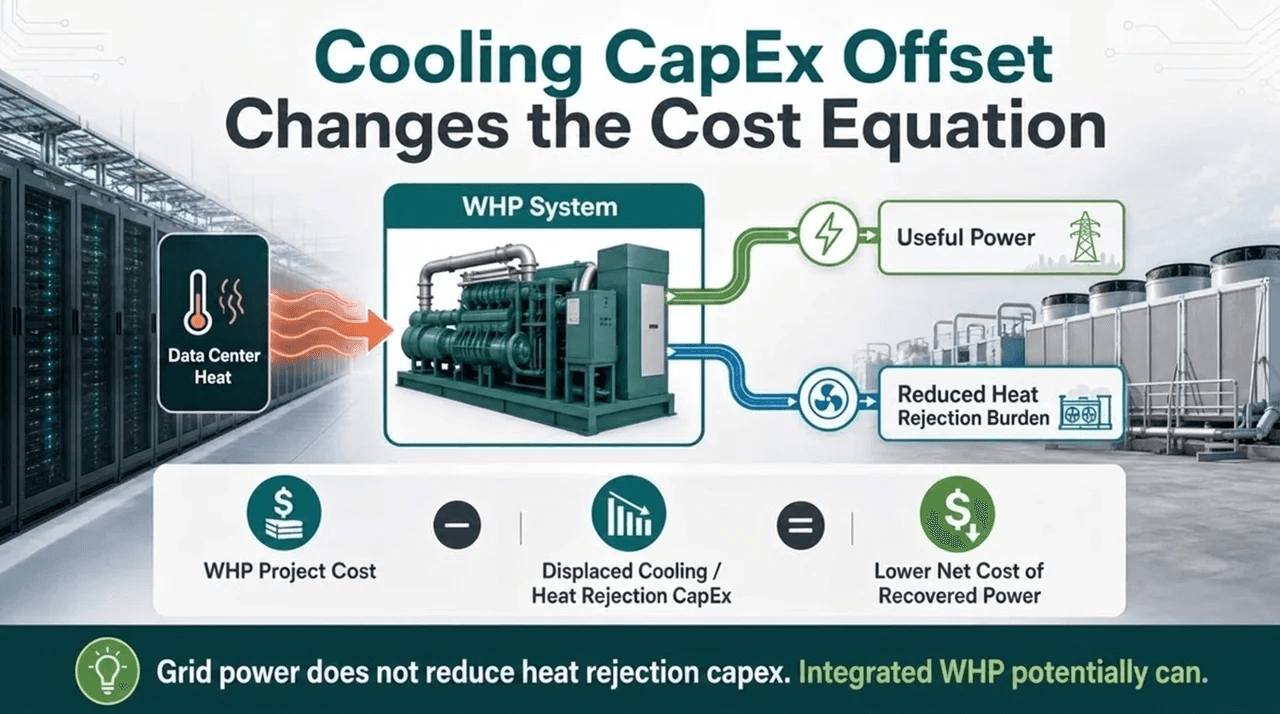
If a waste heat power system can perform part of that heat rejection function while also producing useful electricity, then part of its cost should be evaluated against the infrastructure it helps offset. This changes the economics.
The relevant question is not only:
How much capex is required to generate power from waste heat?
It is also:
How much conventional cooling or heat rejection capex is reduced because the system is integrated into the site?
That avoided capex can materially change the net cost of recovered power.
This is where many traditional comparisons fail.
They compare waste heat power against grid power as though both are simply electricity sources. But grid power does not reduce dry cooler capex. It does not absorb thermal load. It does not reduce the heat rejection burden. It does not make use of the facility’s existing waste heat stream.
Waste heat power can potentially do all of those things.
That is why the comparison has to be infrastructure-adjusted.
Behind-the-Meter Power Has a Different Value
Behind-the-meter power can be especially valuable in constrained data center markets.
Grid power is not just about price. It is also about access.
Many data center projects are delayed or limited by interconnection timelines, utility capacity, transmission constraints, substation availability, and local permitting friction.
In that environment, any reliable behind-the-meter megawatt can be more valuable than its nominal cost suggests.
A recovered megawatt inside the facility can:
• Reduce marginal grid draw
• Support additional IT load
• Reduce dependence on external infrastructure
• Improve the economics of a constrained site
This matters because data center economics are often driven by usable capacity.
A site that can support more IT load with the same grid allocation may create value far beyond the commodity price of electricity.
The more constrained the site, the more valuable behind-the-meter power becomes.
Load Matching and Emissions Matter
Timing also matters.
Solar and wind can be cost-effective, but their production profiles do not automatically match data center load. Both may require storage, grid balancing, or contractual structures to match a continuous data center operating profile.
Waste heat power has a different profile.
A data center produces more heat when it consumes more power. That means waste heat power can be naturally linked to the facility’s own load.
When IT load is higher, heat generation is higher. When heat generation is higher, the opportunity for heat recovery can also increase.
A power source that follows the facility’s operating profile may be more valuable than one that produces at the wrong time, even if the headline LCOE appears similar.
Similarly, emissions should also be evaluated at the margin. The relevant question is not only whether recovered power is clean in abstract terms. The better question is what it displaces.
If waste heat power reduces grid consumption during periods when the marginal grid generator is fossil-based, it can reduce substantial emissions. If it reduces reliance on diesel backup, gas generation, or other higher-emission sources in certain operating scenarios, the emissions benefit may be even larger.
A recovered behind-the-meter megawatt should be evaluated based on the power and infrastructure it actually displaces.
Resilience and Infrastructure Dependence Matter Too
Data center power architecture is increasingly about resilience.
Operators are not only asking what power costs. They are asking:
• How quickly can we get it?
• How reliable is it?
• How exposed are we to grid constraints?
• How much redundancy do we need?
• How do infrastructure choices affect uptime?
Waste heat power can contribute to that discussion because it is embedded inside the site.
It can reduce dependence on external grid supply at the margin. It can reduce dependence on alternative infrastructure. It can create another source of useful energy from a thermal stream that already exists.
It can also potentially reduce the size or operating burden of other systems such as backup power.
That does not replace the need for robust electrical and mechanical redundancy. Data centers still require conservative design, bypass capability, fail-safe integration, and clear operational boundaries.
But an integrated waste heat power system can become part of a broader resilience strategy.
That value is difficult to capture in a simple LCOE figure.
The Right Comparison Is Infrastructure-Adjusted Cost
The market needs a better cost framework for waste heat power.
A narrow comparison asks:
What is the levelized cost of the electricity produced?
A better comparison asks:
What is the net cost and value of the recovered power after accounting for infrastructure effects?
That includes:
• Recovered electricity output
• Displaced cooling or heat rejection capex
• Reduced peak capacity requirements
• Reduced dependence on constrained grid infrastructure
• Improved behind-the-meter resilience
• Potential emissions reduction from displaced marginal power
• Load-following value
• Site-specific capacity value
This does not make the analysis simpler, but it makes it more accurate.
A recovered megawatt from waste heat may or may not always be the cheapest megawatt on a pure generation basis. But it may be one of the most valuable megawatts inside a constrained data center architecture.
Where SPRING Fits In
This is where Spar’s SPRING system fits into the broader data center power architecture conversation.
SPRING is not just about producing electricity from low-grade waste heat. The more important question is how that recovered power fits into the site’s full infrastructure model.
If a system can recover useful power from data center thermal loops while also contributing to heat rejection strategy, then it should be evaluated as integrated infrastructure, not as a stand-alone generator.
For this reason, SPRING should be assessed not only on recovered kWh, but on net site value: avoided or deferred heat rejection capex, behind-the-meter power value, load-linked generation, and resilience contribution. In some sites, the highest-value deployment may not be the one with the lowest pure generation LCOE, but the one that improves the overall data center power and cooling architecture.
About
Let’s Talk

Assess Your Data Center Waste Heat Reuse Opportunity
We analyze your facility to quantify power recovery, efficiency gains, and integration opportunities.
Explore SPRING Pilot Programs
Get in touch to evaluate a pilot and validate performance in your environment.

104 West 40th Street, New York, NY 10018