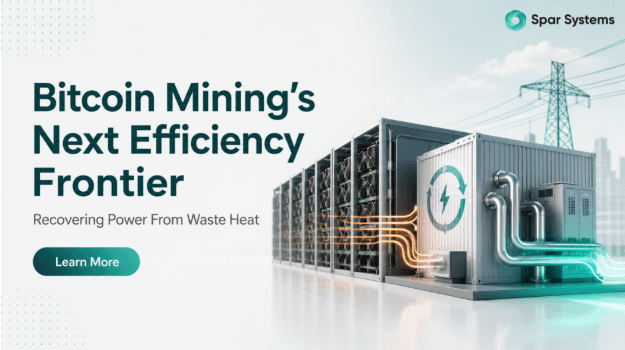
Bitcoin Mining’s Next Efficiency Frontier: Recovering Power From Waste Heat
Headline
Bitcoin mining has historically been driven by one dominant variable: power cost. For years, operators focused on lower-cost electricity, stranded energy, flare gas, immersion cooling, overclocking, and generation optimization. But a new bottleneck is emerging: thermal efficiency. Modern mining campuses increasingly resemble other high-density compute environments, with rising power density, faster liquid cooling adoption, more onsite generation, and larger volumes of rejected low-grade heat. That creates a new opportunity. If useful power can be recovered from waste heat that is already being produced, mining economics, fuel efficiency, and site capacity could all improve without requiring additional grid power or fuel.
Bitcoin mining has historically been constrained by one dominant variable: power cost.
For years, the industry focused primarily on:
Lower-cost electricity
Stranded energy
Flare gas
Immersion cooling
Overclocking
Generation optimization
But a new bottleneck is emerging:
Thermal efficiency.
Modern mining campuses increasingly resemble high-density compute facilities:
Power densities are rising
Liquid cooling adoption is accelerating
Onsite generation is becoming common
More total site energy is being rejected as low-grade heat
Today, nearly all of that energy is wasted.
That creates a major opportunity.
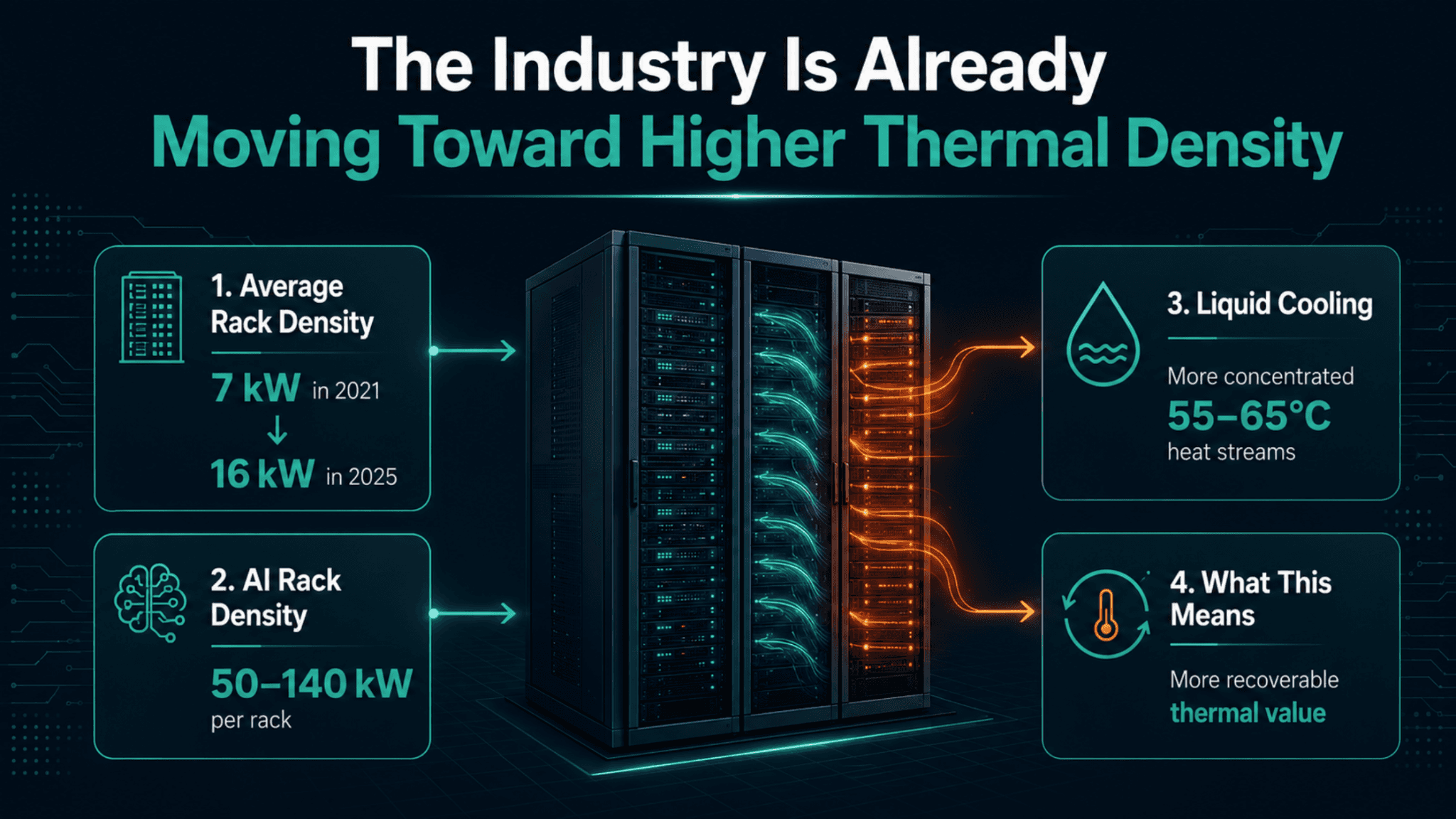
The Industry Is Already Moving Toward Higher Thermal Density
Many of the largest mining operators are already shifting aggressively toward:
Immersion cooling
Liquid cooling
Modular high-density deployments
Vertically integrated energy infrastructure
Examples include:
Riot Platforms’ Corsicana development, which includes large-scale immersion-cooled infrastructure and is positioned among the industry’s major high-density mining campuses
CleanSpark’s immersion and liquid-cooled infrastructure, including large-scale deployments focused on reducing cooling energy and increasing compute density
MARA’s broader move toward integrated power-plus-compute infrastructure, including direct involvement in generation assets and energy-backed digital infrastructure
Cipher Mining’s growing use of high-density campuses where thermal management and infrastructure efficiency are becoming more important competitive variables
This trend matters.
As rack densities rise and liquid cooling adoption accelerates, the temperature and quality of recoverable thermal streams improves substantially.
The mining industry is unintentionally building the conditions required for practical ultra-low-temperature waste heat recovery.
The Untapped Energy Stream Inside Bitcoin Mining
A typical Bitcoin mining operation converts nearly all consumed electrical energy into heat.
Examples:
A 100 MW mining campus ultimately rejects approximately 100 MW of thermal energy
Large liquid-cooled ASIC deployments often operate with coolant temperatures in the 50–75°C range
Gas-powered mining sites reject even more energy through engine exhaust, jacket water, aftercoolers, and cooling systems
Historically, this heat has been considered too low-temperature for practical power recovery.
Conventional waste heat recovery systems generally require:
Steam conditions
High exhaust temperatures
Large thermal gradients
Utility-scale infrastructure
As a result, ultra-low-temperature heat recovery has remained commercially impractical for mining environments.
Until now.
Why Bitcoin Mining Is Uniquely Positioned for Waste Heat-to-Power
Bitcoin mining is arguably one of the strongest deployment environments for next-generation waste heat recovery systems.
Unlike many enterprise data centers, mining operators:
Are highly sensitive to marginal efficiency gains
Frequently operate onsite generation
Already optimize around thermodynamics
Directly monetize every incremental kilowatt-hour
Even relatively small improvements can materially affect:
Hash rate economics
Fleet competitiveness
Shutdown thresholds during bear markets
Fuel utilization efficiency
That makes crypto mining an industry where power regeneration from waste heat can be a major economic unlock.
Quantifying the Opportunity
Consider a representative large mining campus:
Parameter | Value |
Site load | 100 MW |
Uptime | 95% |
Power cost | $0.05/kWh |
Annual electricity spend | ~$41.6M |
A modern mining operation of this scale may generate:
Approximately $70M annual revenue
EBITDA margins around ~23%
Backend Recovery Only (Mining Cooling Infrastructure)
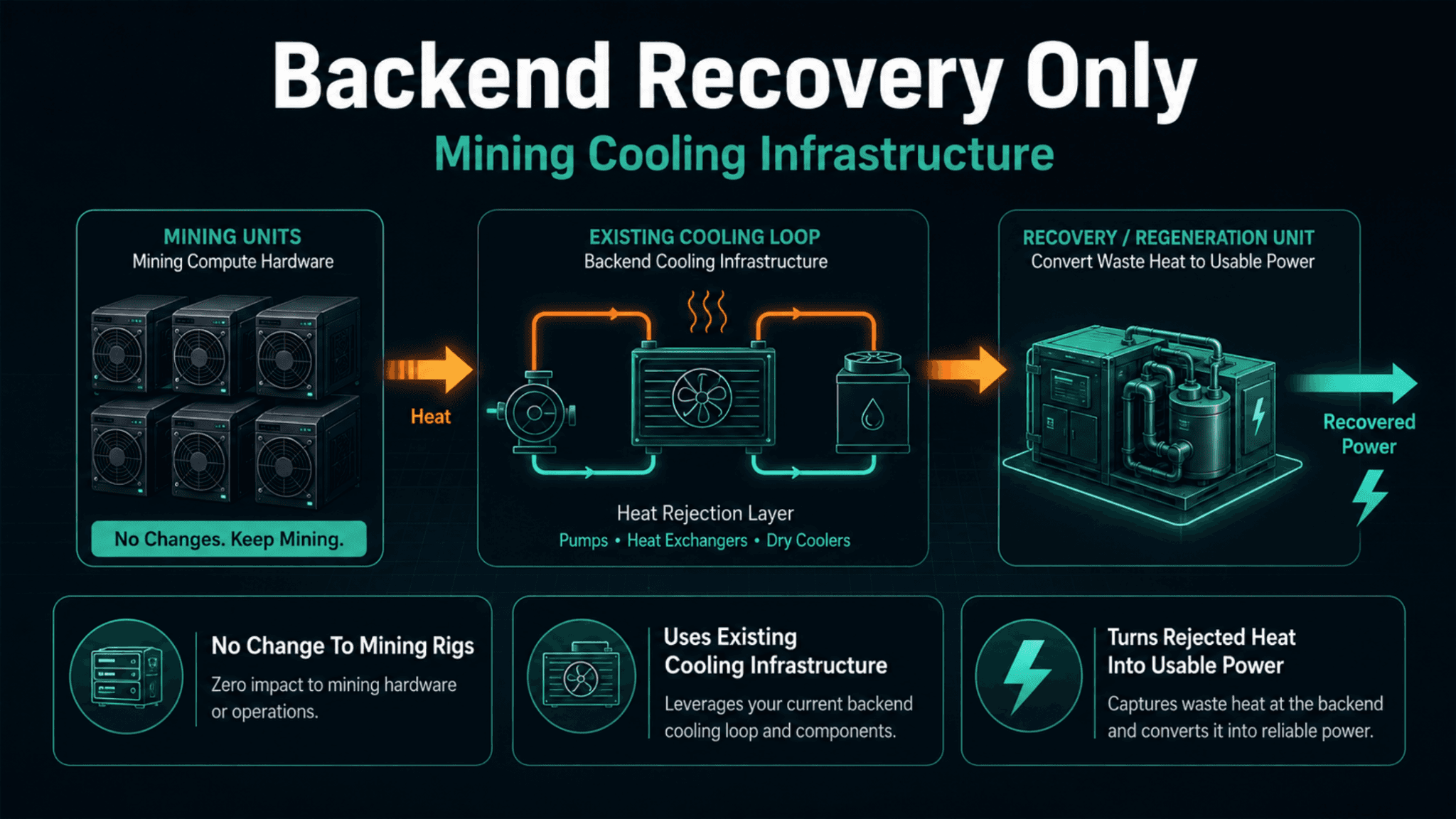
Now consider deployment of a next-generation waste heat recovery system on the backend cooling infrastructure alone:
Liquid cooling loops
Immersion systems
Primary thermal rejectors
Assume:
~9% combined impact from recovered electrical power and avoided cooling parasitic load
This corresponds to approximately:
100 MW × 9% = 9 MW
of effective recovered capacity.
Over a year, this represents approximately:
~$3.7M/year in recovered energy value
Resulting mining economics:
Metric | Before | After |
EBITDA | $16.4M | $20.1M |
EBITDA Margin | 23% | 29% |
That corresponds to:
~23% EBITDA improvement
Importantly, this does not require:
Additional grid power
Additional utility allocation
Additional fuel consumption
The site simply extracts more useful work from energy already being consumed.
Combined Backend + Frontend Recovery
The opportunity becomes substantially larger for mining operations using onsite generation.
Many large miners today already deploy:
Reciprocating gas engines
Turbines
Flare gas systems
Stranded gas infrastructure
Behind-the-meter generation
These systems reject enormous amounts of thermal energy through:
Engine exhaust
Jacket water
Charge air cooling
Generator cooling systems
Mining cooling infrastructure itself
In these deployments, waste heat recovery can potentially operate on:
Backend mining thermal loops
Frontend power-generation thermal streams simultaneously
Example Combined Case
Assume:
A 100 MW mining operation
Powered primarily by onsite gas generation
Typical reciprocating gas engine systems may operate around:
~45% electrical efficiency
This means substantially more thermal energy is rejected than converted into electricity.
Using combined frontend and backend waste heat recovery, estimated impact:
~27 MW equivalent total recovered capacity
This corresponds to:
100 MW + 27 MW = 127 MW effective capacity
without requiring additional:
Utility allocation
Fuel supply
Interconnection capacity
Annual recovered energy value:
Approximately ~$11.4M/year
Resulting economics:
Metric | Before | After |
EBITDA | $16.4M | $27.8M |
EBITDA Margin | 23% | ~40% |
This corresponds to approximately:
~70% EBITDA improvement
In practice, waste heat recovery becomes:
A fuel-efficiency improvement
A cooling optimization layer
A compute-capacity multiplier
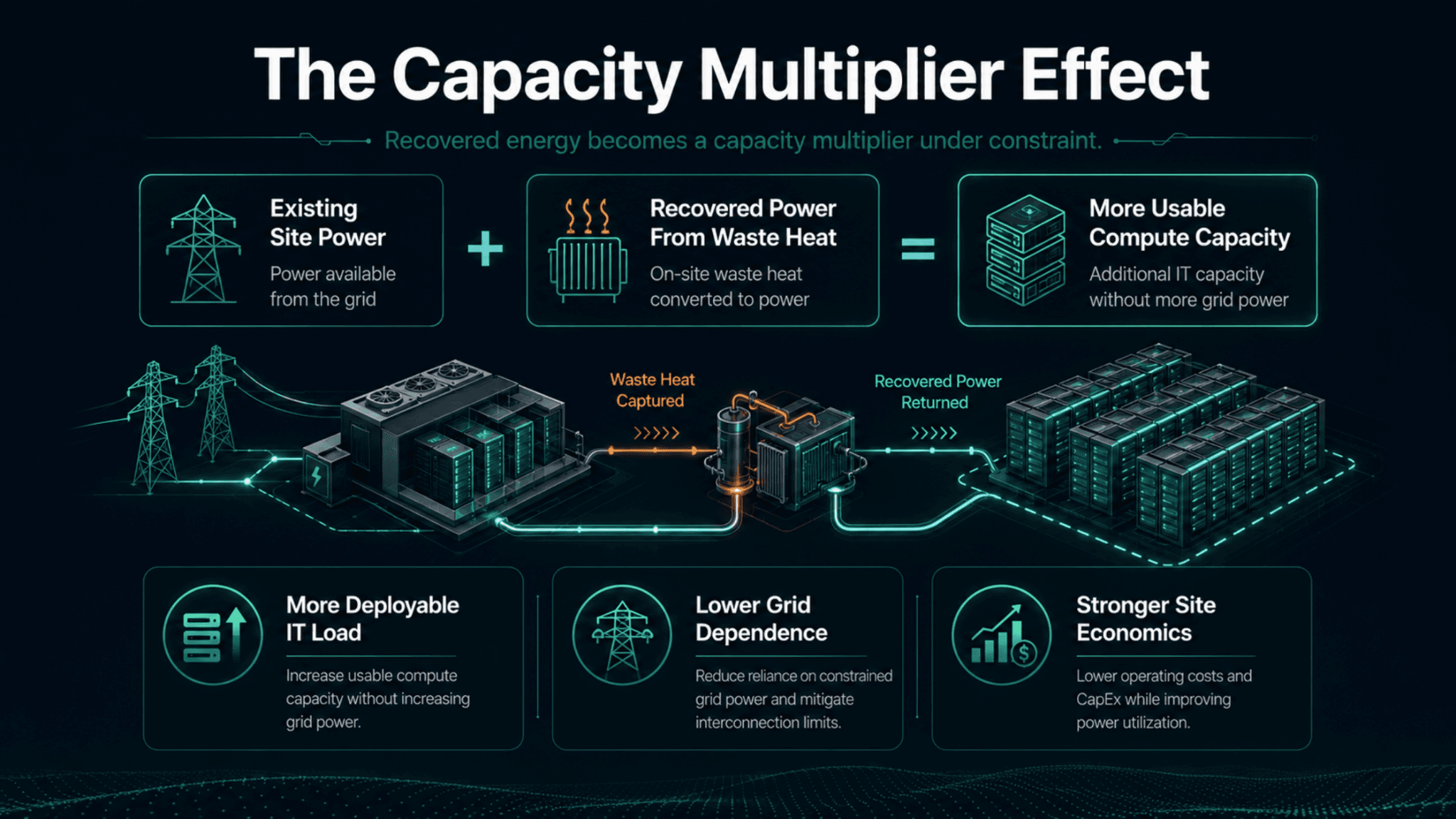
The Capacity Multiplier Effect
One of the most important implications is not simply energy savings.
It is capacity expansion.
Many mining operations today are constrained by:
Utility allocations
Transformer limits
Substation capacity
Interconnection bottlenecks
Onsite generation limits
If a mining site consuming 100 MW can internally regenerate substantial usable power from existing waste heat streams, the result is effectively:
Additional deployable ASIC capacity
Higher site hash rate
Improved revenue generation
No need for additional grid approvals
In practice, waste heat recovery becomes a form of infrastructure multiplication.
Why Traditional Recovery Systems Do Not Fit Mining
Most existing waste heat recovery technologies struggle in mining environments for several reasons.
1. Temperature Limitations
Conventional systems generally target:
High-temperature industrial exhaust
Steam cycles
ORC systems with large temperature differentials
Utility-scale CHP applications
Mining thermal streams are fundamentally different:
Lower temperatures
Distributed heat rejection
Variable load profiles
Rapid transients
Highly space-constrained deployments
This is especially true for:
Liquid-cooled ASIC loops
Immersion systems
Air-side rejectors
2. Cooling Integration Complexity
Most power recovery systems are not designed to integrate directly into:
Mining cooling loops
Dry coolers
Immersion infrastructure
Modular containerized deployments
This creates:
Excessive parasitic losses
Operational complexity
Poor economics
3. Economic Mismatch
Mining operators require:
Compact systems
Modular deployment
Rapid payback
High uptime
Meaningful economics even at relatively low thermal efficiencies
Traditional systems were not designed around these constraints.
A Different Architecture for Ultra-Low-Temperature Recovery
Spar Systems is developing a fundamentally different category of thermal recovery system optimized specifically for:
Ultra-low-temperature heat
Distributed thermal streams
Modular infrastructure
High-density cooling environments
The system is designed to:
Operate at temperatures previously considered uneconomic
Integrate directly into cooling infrastructure
Reduce heat rejection load
Regenerate usable electrical power from waste thermal streams
Importantly, the architecture is designed around the realities of modern compute infrastructure:
Variable thermal loads
Liquid cooling
Modular deployment
High-density operation
This opens deployment opportunities that conventional recovery systems have historically been unable to address.
Conclusion
For more than a decade, Bitcoin mining innovation focused primarily on:
Cheaper power
Faster ASICs
Improved cooling
The next major frontier may be different:
Recovering power from the heat already being produced.
The scale of recoverable energy inside modern mining infrastructure is enormous.
Until recently, ultra-low-temperature recovery was considered commercially impractical.
That assumption is beginning to change.
—————————————————————
Reference Links
Riot Platforms – Corsicana Facility
https://www.riotplatforms.com/bitcoin-mining/corsicana/CleanSpark – Next-Generation Data Center Developer
https://www.cleanspark.com/CleanSpark – 2021 Immersion Cooling Initiative
https://investors.cleanspark.com/news/news-details/2021/CleanSpark-Announces-New-20-MW-Immersion-Cooling-Initiative-at-Norcross-Bitcoin-Mining-Facility-12-09-2021/default.aspxMARA – Energy and Infrastructure Direction
https://www.mara.com/posts/bitcoin-mining-the-key-to-solving-renewable-energy-intermittencyReuters – MARA Power Generation Pilot
https://www.reuters.com/technology/cryptominer-mara-taps-us-shale-patch-power-generation-new-pilot-program-2024-10-08/Cipher Mining – Black Pearl Expansion Coverage
https://www.mrt.com/business/oil/article/cipher-mining-black-pearl-texas-20027199.phpVertiv – High-Density Cooling Guide
https://www.vertiv.com/en-us/insights/articles/educational-articles/high--density-cooling-a-guide-to-advanced-thermal-solutions-for-ai-and-ml-workloads-in-data-centers/ORNL / Low-Temperature Recovery Context
https://info.ornl.gov/sites/publications/Files/Pub164247.pdf
About
Let’s Talk

Assess Your Data Center Waste Heat Reuse Opportunity
We analyze your facility to quantify power recovery, efficiency gains, and integration opportunities.
Explore SPRING Pilot Programs
Get in touch to evaluate a pilot and validate performance in your environment.

104 West 40th Street, New York, NY 10018