Waste Heat to Power in Data Centers: The Industry’s Largest Unused Energy Resource
Data center energy strategy is beginning to change in a meaningful way. As AI workloads increase rack density, cooling intensity, and pressure on grid access, waste heat can no longer be viewed only as a thermal byproduct to remove. The scale is already significant, but the more important shift is strategic: operators may need to evaluate waste heat recovery not just as an efficiency measure, but as part of capacity planning, site economics, and infrastructure design. In a market where power availability increasingly shapes growth, this creates a new question for the industry: how much useful value can be recovered from the energy that is already moving through the facility?
For years, the data center industry has treated heat as a byproduct that needs to be removed as efficiently as possible. Power enters the facility, powers compute, and nearly all of it eventually leaves as heat.
That model is becoming harder to justify.
As AI infrastructure expands, rack densities rise, and power availability becomes a bigger constraint, waste heat is starting to look less like a disposal problem and more like a stranded energy resource. In practical terms, one of the largest unused energy opportunities in the data center sector is already sitting inside the facility.
Key Numbers at a Glance
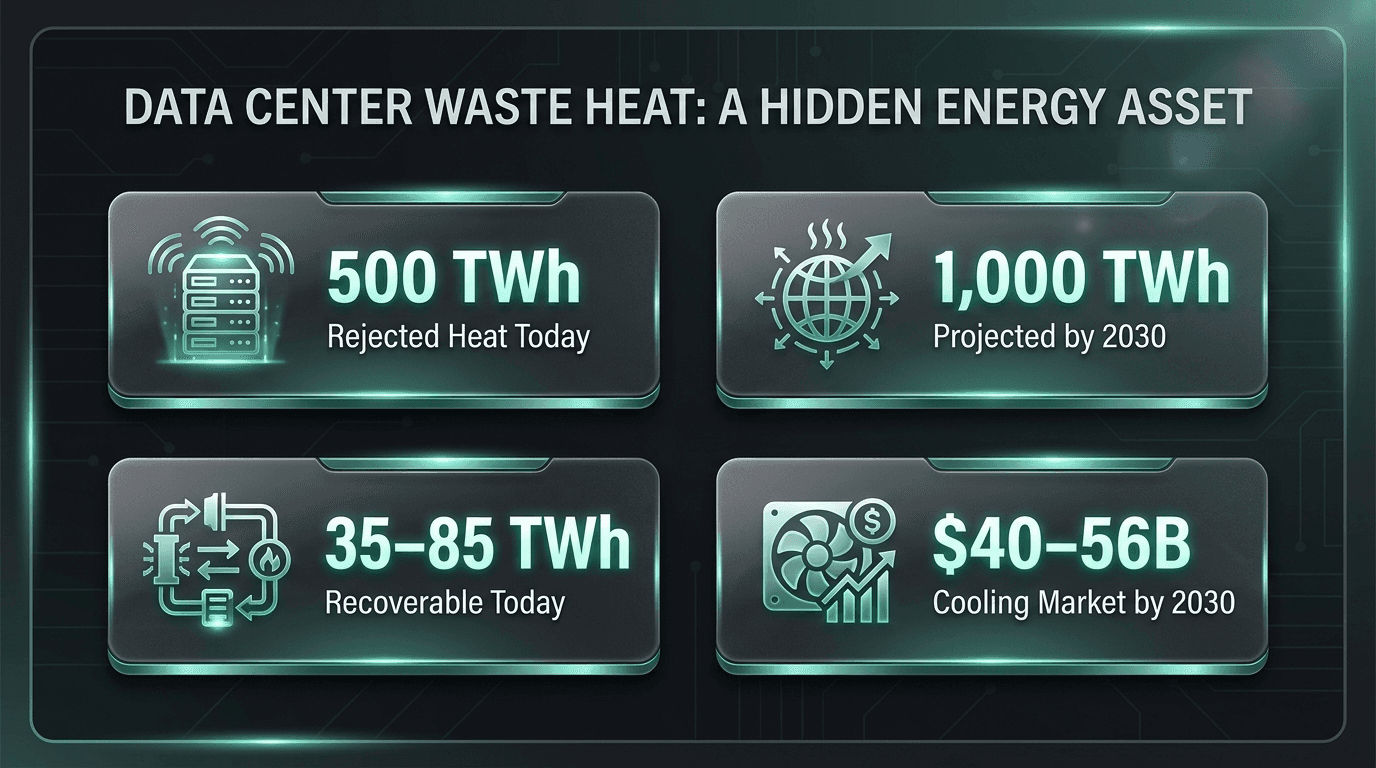
~500 TWh of thermal energy is rejected by data centers today
That could grow to ~1,000 TWh by 2030
Academic estimates suggest 35–85 TWh is already recoverable today
The industry is building a $40–56 billion cooling market largely to remove this energy
In the U.S. overall, 18,024 TWh of primary energy is rejected as waste heat annually
These are not small numbers. They point to a large and increasingly valuable energy stream that the industry still mostly pays to reject.
A Massive Energy Resource Hiding in Plain Sight
Data centers are large energy conversion systems. Electricity enters the site, powers servers, and almost all of that energy ultimately turns into heat.
That is why the scale matters so much.
Today, the data center industry is estimated to reject roughly 500 TWh of thermal energy every year. By 2030, that figure could approach 1,000 TWh. Even if only a portion of that heat can be economically recovered, the opportunity is still significant.
The broader energy picture makes the point even clearer. In the United States alone, more than 18,000 TWh of primary energy is rejected as waste heat each year. Waste heat is already one of the largest inefficiencies in modern infrastructure. Data centers are becoming one of the most concentrated and valuable parts of that problem.
Why This Matters More Now
For a long time, low-temperature waste heat was often dismissed as too diffuse or too low-grade to be worth recovering. That assumption is becoming less valid.
The data center industry is changing quickly.
Average rack density has increased from 7 kW in 2021 to 16 kW in 2025. AI-focused deployments are operating at much higher levels, often in the range of 50–140 kW per rack.
That shift matters because higher-density environments create more concentrated and more structured heat streams. As liquid cooling adoption increases, the case for heat recovery becomes stronger. At the same time, power constraints are becoming more serious across major data center markets.
This is why waste heat is no longer just a thermal management topic. It is becoming a capacity, infrastructure, and site economics topic.
Why Now
Higher Rack Density
Faster Liquid Cooling Adoption
Tighter Grid Conditions
Rising Value of Each Available Megawatt
Stronger Economics for Heat Recovery
The Value of a Megawatt Is Different Inside a Data Center
A megawatt inside a data center is not valued like a normal megawatt on the grid.
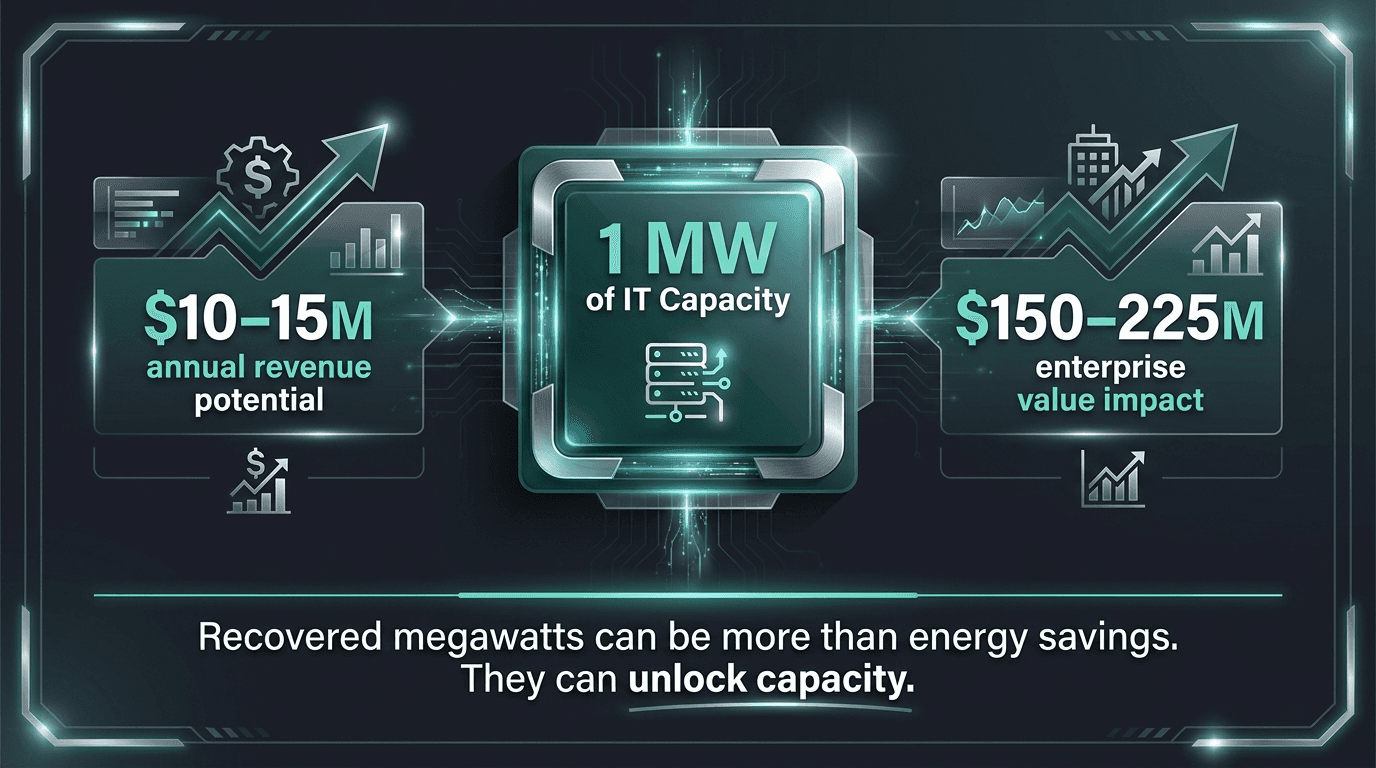
For a hyperscaler, 1 MW of IT capacity can represent roughly $10–15 million in annual revenue. At typical hyperscaler revenue multiples, that same megawatt can imply $150–225 million in enterprise value.
That is why recovered power matters.
This is not just about saving on the utility bill. In a constrained market, recovered power can help support additional capacity, reduce grid dependence, and improve the economics of expansion.
A recovered megawatt can create value in several ways:
Reduce Net Grid Dependence
Support Capacity Growth
Improve Site Efficiency
Lower Wasted Cooling Energy
Increase the Productivity of Existing Infrastructure
In other words, waste heat recovery is not only an efficiency play. In the right context, it is a commercial capacity play.
The Cooling Bill Is Also a Disposal Bill
The industry is spending heavily to move heat and reject it.
By 2030, the data center cooling market is projected to reach $40–56 billion. Much of that spending is tied to the traditional design assumption that heat is something to remove, not something to use.
That is the core inefficiency.
The sector is building a large market around disposing of energy that already has potential value. Waste heat to power changes the equation by treating part of that thermal output as an input for useful work.
This is where the conversation begins to shift. The question is no longer only how to reject heat more efficiently. The question is how much of that heat can be put to work before it is wasted.
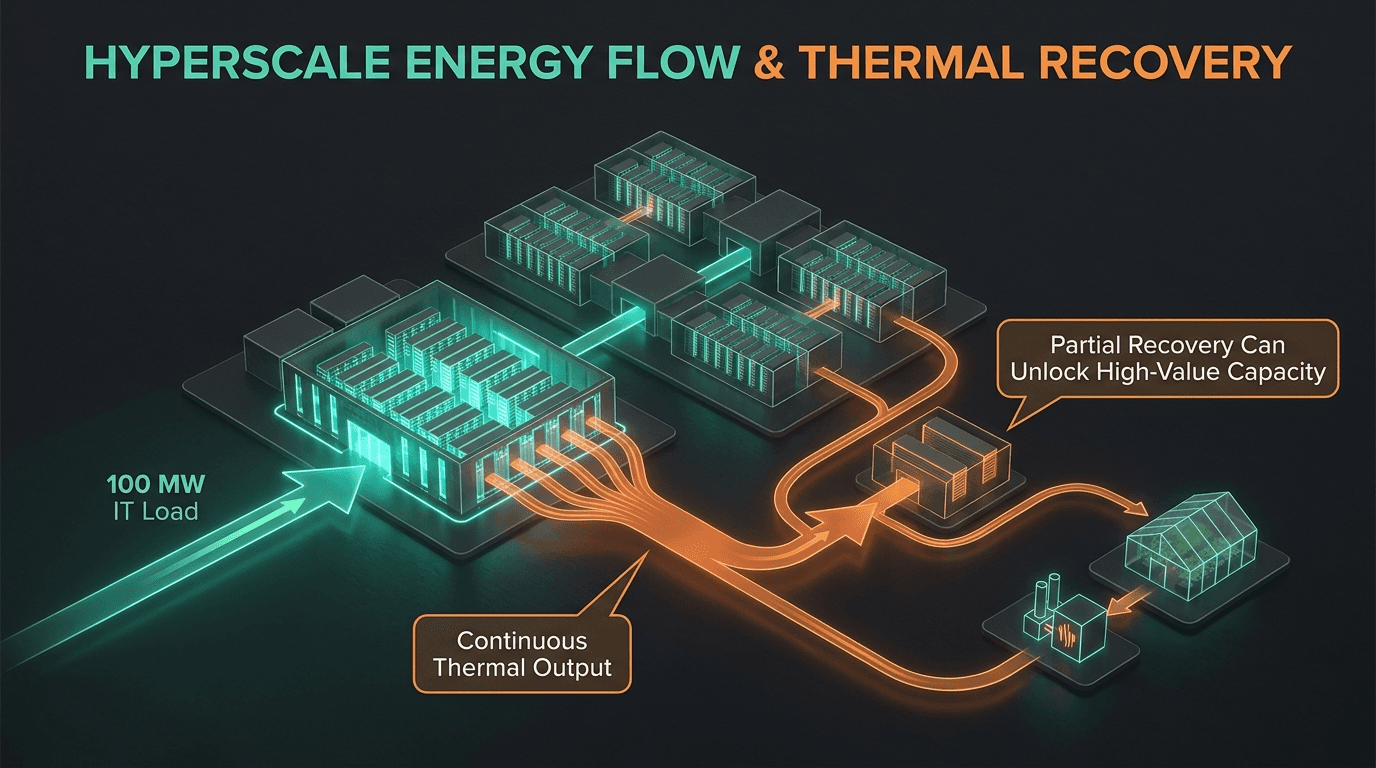
A 100 MW Data Center Is Also a Thermal Power Source
A 100 MW data center does not just consume power. It also produces an enormous and continuous thermal stream.
That heat already exists. The question is not whether it is there. The question is how much value can be recovered from it.
Even partial recovery can matter. In constrained regions, each usable megawatt can carry high commercial value. Recovering part of the site’s wasted thermal energy can support lower grid dependence and stronger site-level economics.
This becomes even more important as larger campus-scale deployments continue to expand. A hyperscale campus measured in hundreds of megawatts or even gigawatts will also generate an equally large thermal opportunity.
At that scale, waste heat is no longer a secondary issue. It becomes part of the site’s energy strategy.
On-Site Generation Makes the Opportunity Even Bigger
The opportunity becomes even more interesting when a site uses behind-the-meter power generation such as reciprocating engines or fuel cells.
These systems do not only produce electricity. They also produce significant heat. In many cases, the thermal output is substantial enough to create another high-value recovery opportunity.
This expands the role of waste heat to power beyond the data hall itself. It becomes part of the full site energy architecture.
That matters because many modern data center campuses are already rethinking how they secure and manage power. As operators look at on-site generation, resiliency, and grid independence, waste heat recovery becomes more relevant as part of an integrated infrastructure strategy.
From Efficiency to Capacity Strategy
Waste heat to power should not be viewed only as an efficiency tool.
In a grid-constrained market, it can also be a capacity strategy. It pushes operators to think beyond lower PUE and toward larger operating questions:
Can this site bring capacity online faster?
Can it reduce grid dependence?
Can it extract more value from existing thermal systems?
That is where the category becomes strategically relevant.
This Is Bigger Than a Cooling Story
Waste heat to power affects more than thermal efficiency alone. It also touches:
Energy Strategy
Thermal Management
Site Economics
Capacity Expansion
Long-Term Infrastructure Planning
This is why the topic deserves more attention than it usually receives. It sits at the intersection of power, cooling, infrastructure, and growth.
A New Design Question for Data Center Operators
For years, the question was how to reject heat more efficiently.
The better question now is this: How much of that heat can be put to work before it is wasted?
As rack density rises, cooling costs grow, and power becomes harder to secure, waste heat is beginning to look less like a byproduct and more like a real infrastructure asset.
The operators who recognize that shift earlier will be in a better position to unlock capacity, improve resilience, and build for the next phase of data center growth.